When parents first come to Potentialz Unlimited, they often have a clear idea of what is happening: their child is struggling, their child needs support, and they are booking their child in for therapy. What sometimes surprises them is the news that they are also part of the therapeutic process.
Not as clients themselves — though their own support matters too. Not as observers who sit in on sessions — that would change the dynamic entirely. But as active participants in a process that, to be effective, needs to extend beyond the therapy room and into the daily life that only they can access.
Play therapy works best when it is understood, supported, and reinforced by the parents who know their child most deeply. This post explains what parent consultations involve, why they matter, and what you can expect when you start a therapeutic journey with your child at Potentialz Unlimited.
Why Parents Are Essential to the Therapeutic Process
Children spend approximately 50 minutes per week in play therapy. They spend the remaining 167 hours of the week with their family.
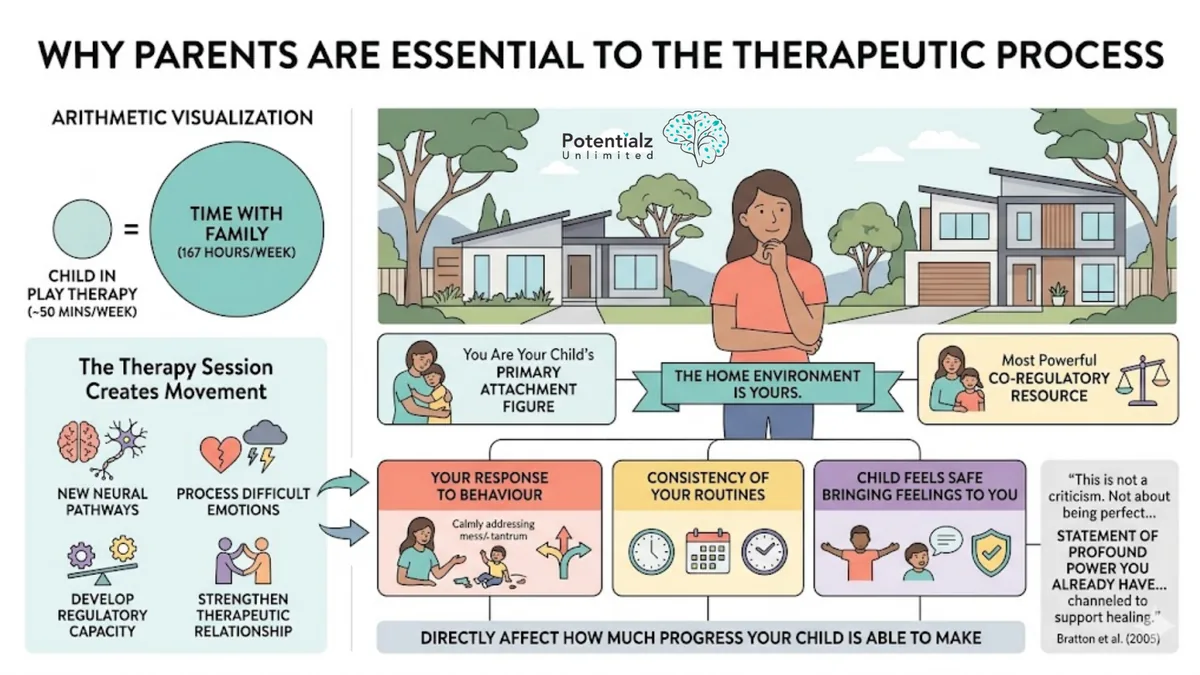
This arithmetic tells us something important: the therapeutic session is the starting point, not the entirety, of a child’s healing. What happens in the therapy room creates movement — builds new neural pathways, processes difficult emotions, develops regulatory capacity, strengthens the therapeutic relationship. But for that movement to consolidate and transfer to everyday life, it needs to be supported in the environment where everyday life actually happens.
That environment is yours.
You are your child’s primary attachment figure. You are the most powerful co-regulatory resource they have. The way you respond to your child’s behaviour, the consistency of your routines, the degree to which your child feels safe bringing their feelings to you — all of these things directly affect how much progress your child is able to make in therapy.
This is not a criticism. It is not about being a perfect parent. It is a statement of the profound power you already have in your child’s life — and how that power can be channelled to support healing (Bratton et al., 2005).
What Happens at the Initial Consultation
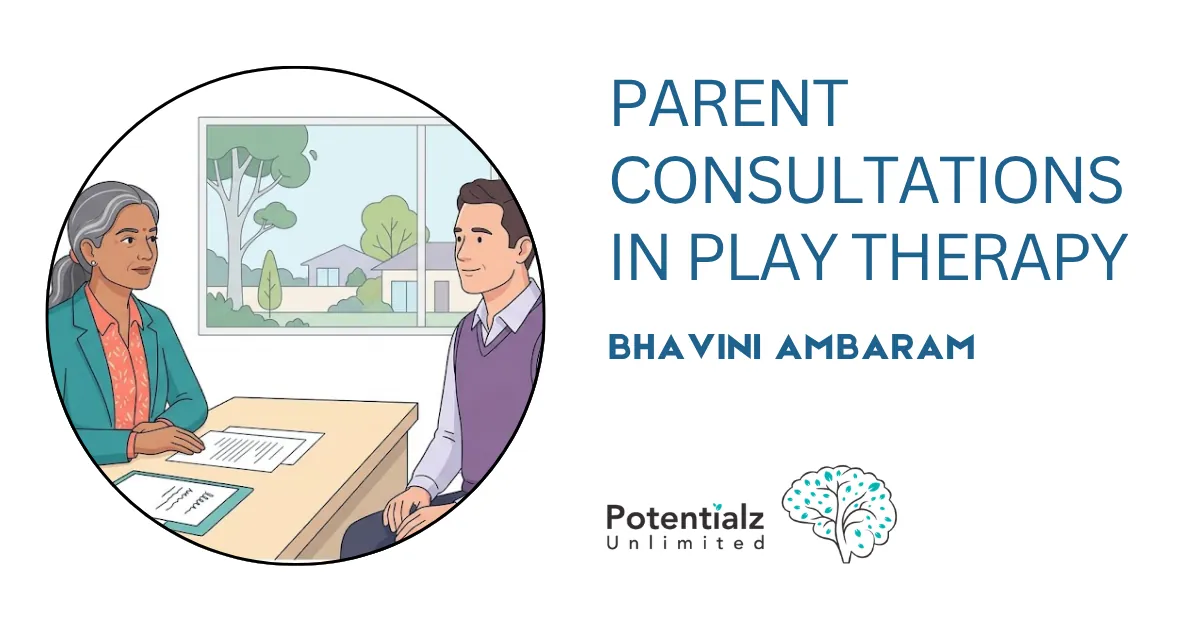
Before your child’s play therapy sessions begin, we meet with you for an initial parent consultation. This session is for you alone — without your child present.
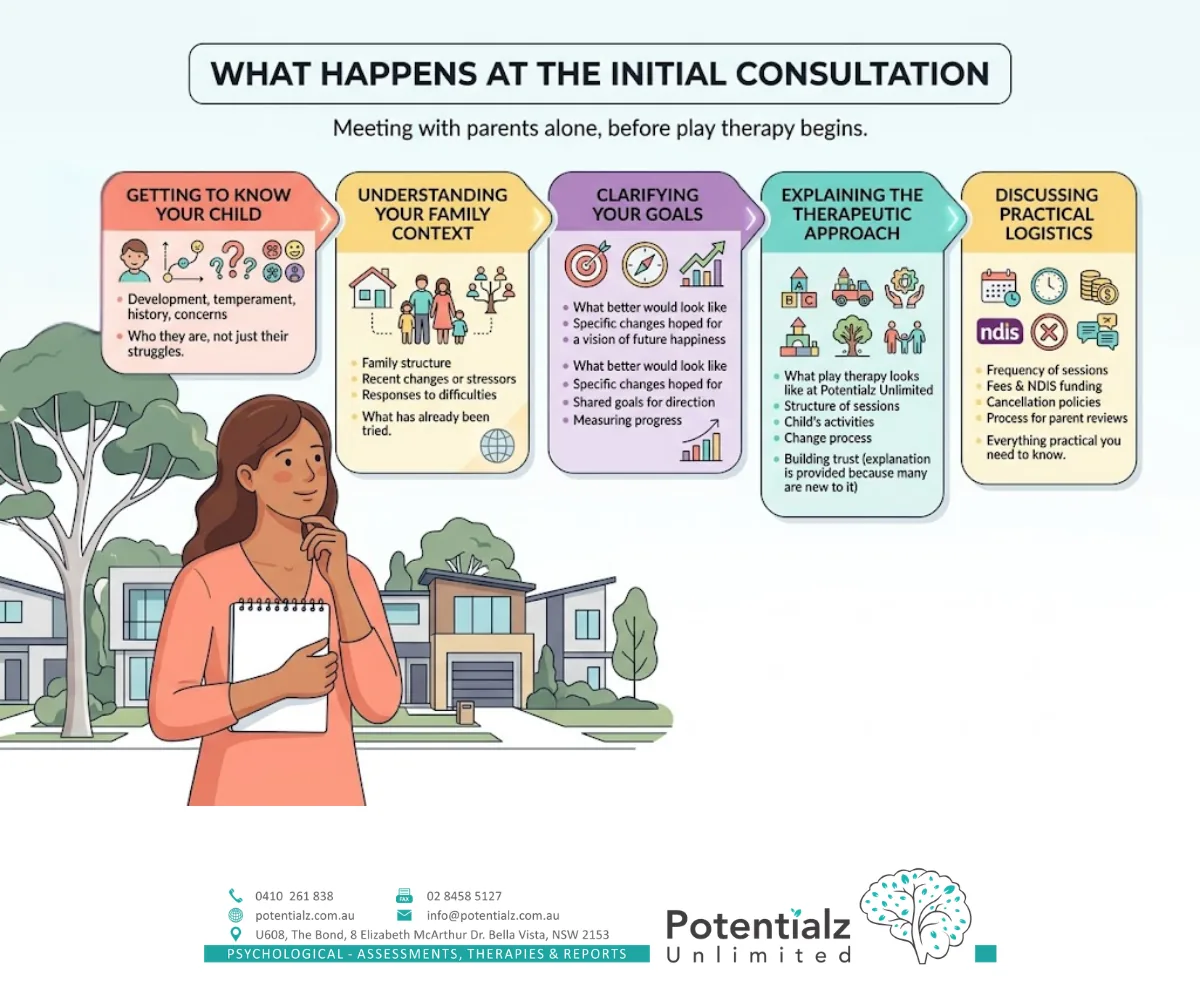
The initial consultation typically includes:
Getting to know your child. Your therapist will ask about your child’s development, their temperament, their history, and the specific concerns that have brought you here. The aim is to understand who your child is — not just what they are struggling with.
Understanding your family context. Children exist within families, and families exist within broader contexts. Your therapist wants to understand the family structure, any recent changes or stressors, how different family members experience and respond to the child’s difficulties, and what has already been tried.
Clarifying your goals. What would it look like if things were better? What specific changes are you hoping for? Establishing shared goals gives the therapeutic process direction and gives us a way to measure progress over time.
Explaining the therapeutic approach. Your therapist will walk you through what play therapy looks like at Potentialz Unlimited — how sessions are structured, what the therapist’s role is, what your child will typically be doing, what the process of change looks like. Many parents have not encountered play therapy before, and understanding the approach helps them trust the process. For a deeper look at one of the approaches our team draws on, see our guide to Synergetic Play Therapy. And where the parent–child relationship itself has been strained by separation, illness, or trauma, Parent–Child Attachment Play brings caregiver and child into sessions together to rebuild that connection.
Discussing practical logistics. Frequency of sessions, NDIS funding, cancellation policies, and the process for parent reviews. Everything practical that you need to know.
The initial consultation lays the groundwork that makes the rest of the work as effective as possible.
What Happens in Ongoing Parent Consultations
Approximately every six weeks, your therapist meets with you again for a parent review consultation.
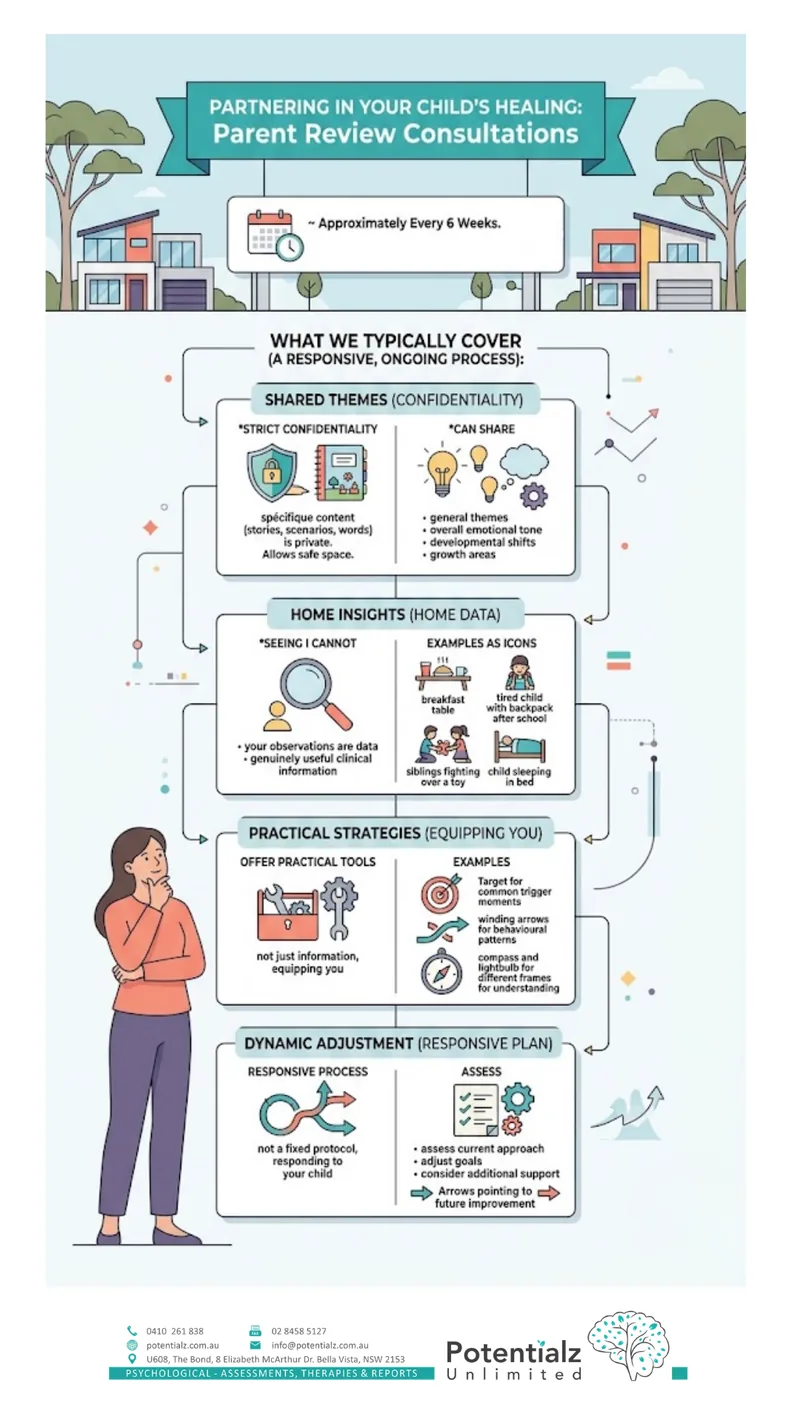
In parent review consultations, we typically cover:
What your therapist is observing in your child’s sessions. The practice maintains strict confidentiality about the specific content of your child’s play — the stories they create, the scenarios they explore, the things they say. This confidentiality is important; it allows your child to use the therapy room as a genuinely safe space. Your therapist can share themes and progress in general terms — the overall emotional tone of the work, the developmental shifts the team is noticing, the areas where growth is happening.
What you are observing at home. You are seeing things your therapist cannot see. Behaviour at breakfast. What your child is like after school. How they respond when a sibling takes their toy. How they sleep. These observations are data — genuinely useful clinical information that helps the team understand how the work is landing in real life.
Practical strategies. Parent consultation is not just about information exchange — it is also about equipping you with practical tools. Depending on what is happening for your child, your therapist may offer specific strategies for common trigger moments, approaches to common behavioural patterns, or simply different frames for understanding what you are seeing.
Adjusting the plan. Play therapy is not a fixed protocol. It is a responsive, ongoing process. Parent reviews are the place where we assess whether the current approach is serving your child well, whether the goals need adjustment, and whether any additional support might be useful.
What You Will NOT Know About Your Child’s Sessions
This is the question almost every parent asks, and it deserves a clear answer.
Your therapist will not tell you what your child plays in their sessions. They will not share specific things your child says, specific scenarios they create, or specific emotions they express. Your child’s therapy session is their confidential space — a space where they can bring their inner world without worrying that it will be reported back to the people they depend on.
This confidentiality is not about keeping secrets from you. It is about creating the conditions in which your child can actually access the therapeutic process. Children who know their parents will hear everything they do and say in therapy will naturally self-censor — which defeats the purpose.
There are important exceptions. If your child discloses anything that raises concerns about their safety — abuse, self-harm, harm to others — your therapist will let you know. Child safety always takes precedence over confidentiality.
What you will know is the general direction of the therapeutic work — the themes, the progress, the areas of focus. You will never be left completely in the dark about your child’s wellbeing.
Common Questions Parents Ask
“Will I be able to see what happens in sessions?” Sessions are not observed by parents. Your presence would significantly change the therapeutic dynamic. You are welcome to wait at Potentialz Unlimited or leave and return.
“What if my child says they don’t want to go?” This is very common, especially early in therapy. Children often resist new things, particularly if they are anxious. In most cases, it is helpful to keep bringing the child — and they often settle into the process more quickly than parents expect. If you are unsure whether therapy is the right step, you may find when to see a child psychologist helpful. Talk to your therapist if this becomes a persistent issue.
“What if I disagree with something that is happening?” Please tell your therapist. Parent consultations are a collaborative space, and your perspective is important. If something in the approach is not fitting with your knowledge of your child, the team wants to know.
“How will I know if progress is happening?” Progress in play therapy often looks different from what parents expect. It is often gradual rather than sudden, and it often shows up in small ways before it shows up in big ones — a slightly less explosive response to frustration, a better night’s sleep, a moment of connection that feels new. We will track progress together in review sessions.
What You Can Do Between Sessions
Parent consultations give you information and strategies. What you do between sessions is what makes that information real.
The most important things parents can do between sessions:
Maintain the routines. Consistent, predictable daily structure is one of the most powerful co-regulatory tools available. If your child’s therapy is addressing anxiety or dysregulation, stable routines at home amplify the in-session work significantly. Parents working with a child whose meltdowns and shutdowns dominate the day may find our post on big emotions in children a useful companion to the strategies coached in sessions.
Stay curious about behaviour. Rather than reacting immediately to difficult behaviour, try to hold a question: “What is my child trying to tell me right now?” This shift from reaction to curiosity does not make difficult behaviour disappear — but it changes the relational quality of the response.
Practise staying regulated yourself. Your nervous system is your child’s most powerful co-regulatory resource. Any work you do to support your own regulation — rest, support, exercise, your own therapy if appropriate — directly benefits your child.
Tell your therapist what you observe. Keep mental notes of what you are seeing — what triggers your child, what helps, what changes you are noticing. Bring these to the review session. They are more useful than you may realise.
Key Takeaways
- Parent consultations are an essential part of play therapy — not optional additions but core components of an effective therapeutic process.
- The initial parent consultation establishes the therapeutic relationship with you, gathers important history and context, and sets shared goals.
- Parent review consultations (approximately every six weeks) allow for information sharing, progress monitoring, and practical strategy development.
- Your child’s session content is confidential — your therapist will share themes and progress, but not specifics — because this confidentiality is what makes the therapy room a genuinely safe space for your child.
- The most powerful things parents can do between sessions are maintaining predictable routines, staying curious about behaviour, and working on their own regulation.
- Children spend most of their lives outside the therapy room — which means parents are the most important element in the child’s healing environment.
How Potentialz Can Help
At Potentialz Unlimited in Bella Vista, parent consultations are a standard part of every child’s therapeutic program. The initial consultation gives us the foundation we need, and the ongoing reviews keep us aligned, responsive, and effective. NDIS self-managed plans are accepted.
If you would like to understand more about the process before committing to sessions, our team is happy to have an initial conversation. You can read more about our child psychology services, explore NDIS-funded support, meet our team, or get in touch.
Book a session online: live.potentialz.com.au Call us: 0410 261 838 Visit us: Unit 608/8 Elizabeth Macarthur Drive, Bella Vista NSW 2153 Hours: Monday to Friday, 10am–7pm | Saturday and after-hours available | Telehealth via phone or Zoom
Related reading
- Play therapy vs talk therapy for children — how to decide — a parent’s decision guide across age, concern and setting.
References
Bratton, S. C., Ray, D., Rhine, T., & Jones, L. (2005). The efficacy of play therapy with children: A meta-analytic review of treatment outcomes. Professional Psychology: Research and Practice, 36(4), 376–390. https://doi.org/10.1037/0735-7028.36.4.376
Guerney, B. G. (1964). Filial therapy: Description and rationale. Journal of Consulting Psychology, 28(4), 304–310. https://doi.org/10.1037/h0041340
Landreth, G. L. (2012). Play therapy: The art of the relationship (3rd ed.). Routledge.
Ray, D. C. (2011). Advanced play therapy: Essential conditions, knowledge, and skills for child practice. Routledge.
Disclaimer: This article is a Potentialz Unlimited editorial piece drawing on our clinical team’s experience. It is for general education and information only, not clinical advice for your particular child. Potentialz Unlimited is a psychology practice based in Bella Vista NSW; our clinical team includes Registered Psychologists and a Clinical Psychologist (registered with AHPRA) and an accredited Play Therapist. Please consult a qualified health professional for your individual circumstances. If your child is experiencing a mental health crisis, contact your GP, call Kids Helpline on 1800 55 1800, or go to your nearest emergency department.
Crisis Resources: If you or someone you know needs support, please contact Lifeline on 13 11 14, Beyond Blue on 1300 22 4636, or Kids Helpline on 1800 55 1800.
Knowledge Check Quiz
Test what you have just read. Choose your answer for each question, then submit to reveal the answers and your score.
Need Professional Support?
If you're experiencing mental health concerns, our team is here to help.