Key Takeaways
- Emotional intelligence (EI) in adulthood is not a personality type — it is a set of four capacities you can grow: self-awareness, self-regulation, social awareness and relationship skill.
- EI shows up most consequentially in two places adults care about: close relationships and work.
- The lived marker of lower EI is not “being an emotional person” — it is a pattern of big reactions, misread signals, strained teamwork and avoided conversations.
- The most reliable practice to build EI is small, daily and three-step: notice the feeling, pause before reacting, respond with intent.
- Reactive responding is led by the feeling of the moment. Regulated responding is led by your values. Both start in the same place; the gap between them is where EI lives.
- This is a Hills District psychology practice primer for adults — the broader science and children’s angle sit in sibling posts linked throughout.
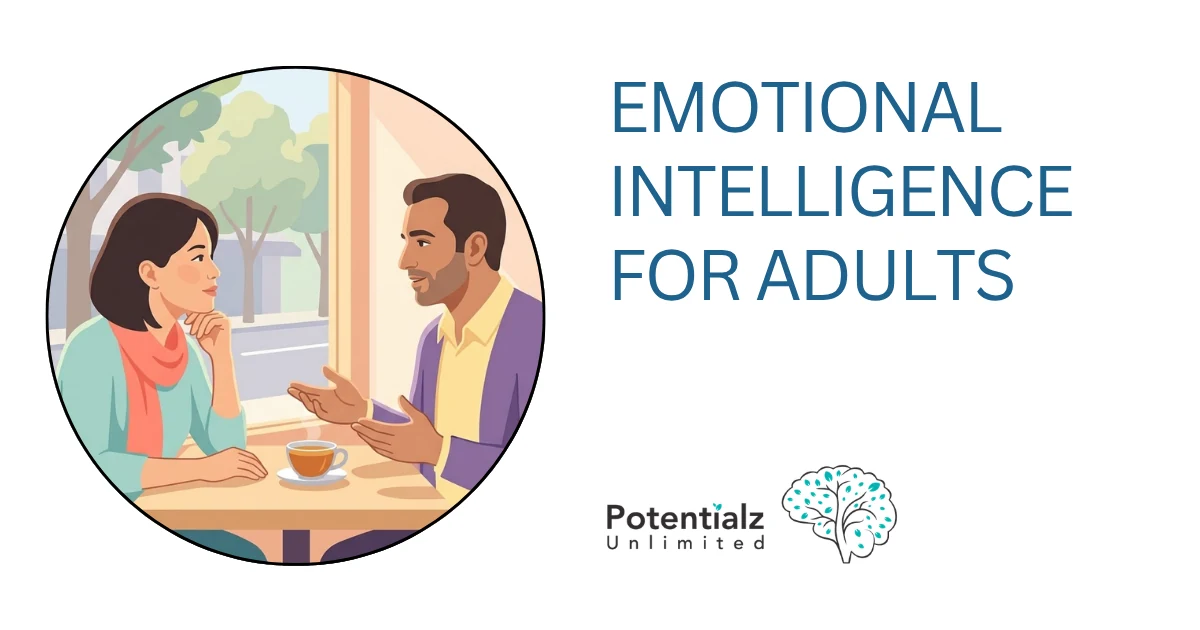
A quiet moment at a sunlit Sydney café — one colleague leans in and listens, the other speaks with soft hand gestures. Neither of them is thinking about emotional intelligence. They are just having a conversation that is, in a small way, going well.
This post is for adults in the Hills District and anywhere else who want more of those conversations — at work, at home, with a partner, with a parent, with themselves — and who sense that something about how they handle feelings and other people is costing them more than it should.
Emotional intelligence (EI) is not a vibe and not a personality type. It is a set of four learnable capacities that work together, and that show up most clearly in the two places adults care about most: relationships and work. If you want the broader science and definitions, our 2024 primer on emotional intelligence as a dimension of human cognitive and social functioning is still the fuller reference. This post is the adult-focused companion — what EI actually looks like at your dinner table and in your team meeting, and what you can do about it this week.
The four capacities, briefly
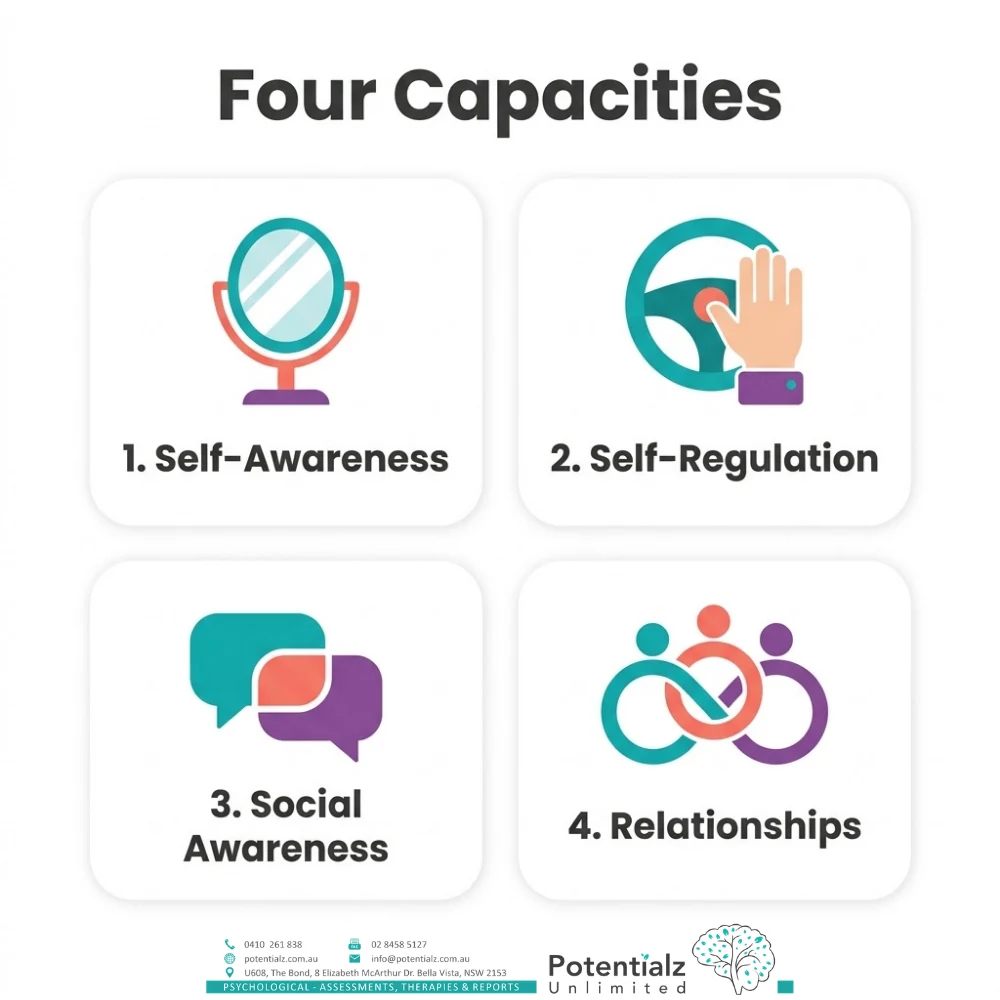
Across the research literature, the four capacities of emotional intelligence cluster into two pairs — one about yourself, one about other people:
- Self-awareness — noticing what you are feeling as you are feeling it, and naming it honestly, including the uncomfortable ones.
- Self-regulation — pausing between the feeling and the response so your values can shape what happens next, rather than the feeling itself.
- Social awareness — reading what is going on for the other person, including what they are not saying.
- Relationships — the day-in, day-out habit of using the first three capacities to make connections stronger, not thinner.
You do not need all four at an advanced level to make life better. You need each one at a workable level, and you need them to speak to each other. Most adults who come to therapy for emotional-intelligence reasons have one strong capacity and one weaker one that is costing them.
Where EI shows up in adult life
Two places. Everywhere else is downstream of these.
In close relationships
A partner saying “I just need you to listen” is a social-awareness cue. Your rising defensive feeling in that moment is a self-awareness cue. The gap between those two cues and your actual response is where emotional intelligence lives.
In adult romantic and family relationships, lower EI tends to show up as:
- Reaching for the quick repair (“fine, I’ll do it your way”) instead of the real conversation.
- Mistaking a bid for closeness as a criticism.
- Mistaking a need for space as a rejection.
- Running the same argument every two months without ever landing on what it is actually about.
Our guide to the four habits of successful relationships walks through the research-backed patterns that distinguish stable adult partnerships — all four habits are, underneath, applied emotional intelligence.
At work
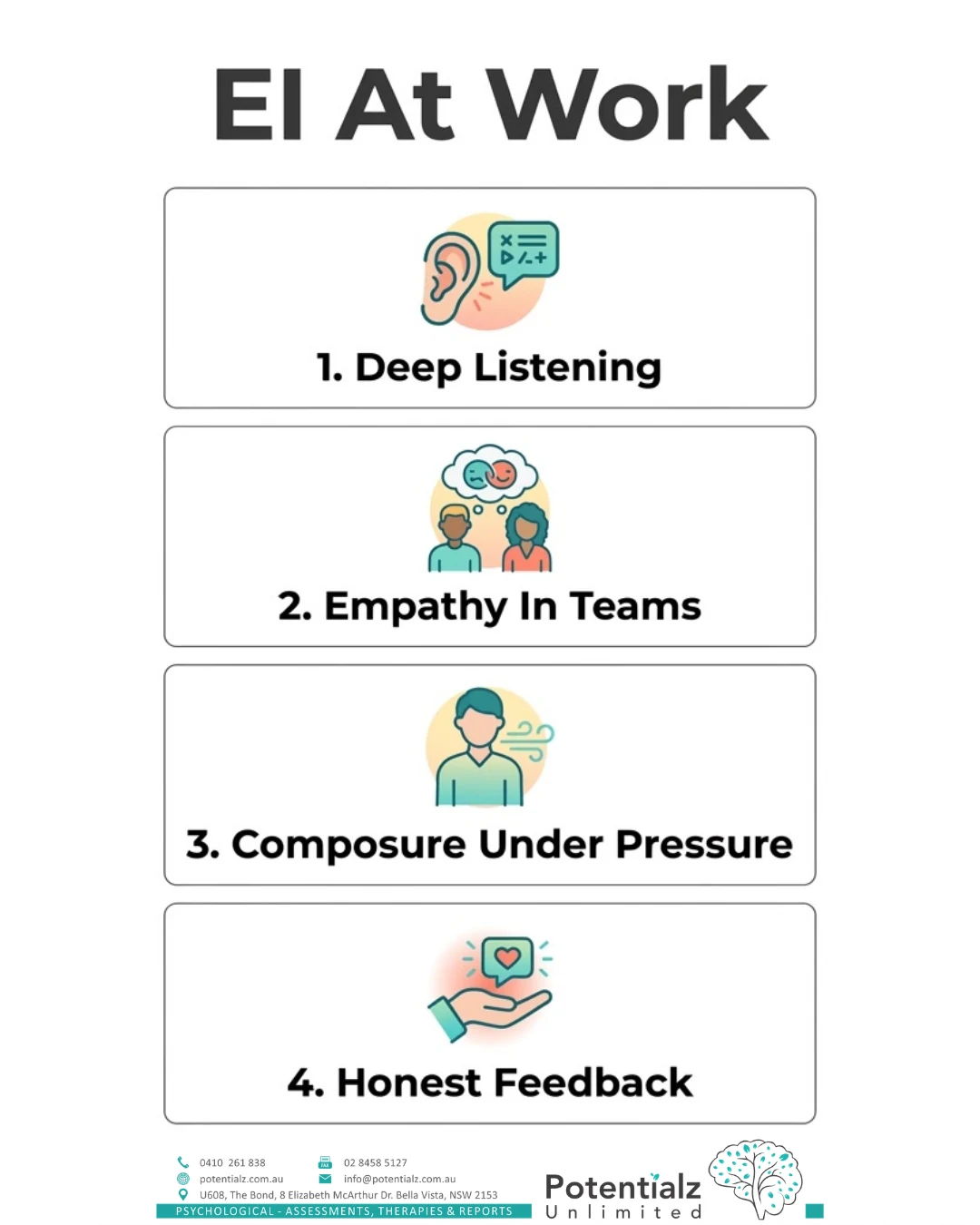
In the workplace, four everyday capacities carry most of the EI weight:
- Deep listening — the willingness to let someone finish without already drafting your reply.
- Empathy in teams — holding the possibility that a colleague’s irritation is about a load you cannot see, not about you.
- Composure under pressure — staying in the conversation when the stakes rise, instead of either escalating or disappearing.
- Honest feedback — the ability to say the useful true thing with care, instead of the comfortable half-thing.
Leaders need these at scale, which is why our post on emotional intelligence as the cornerstone of effective leadership treats EI as the first-order skill in the leader’s toolkit. But every adult in a team needs them, and they do not require a leadership title to practise.
Signs lower EI is getting in your way
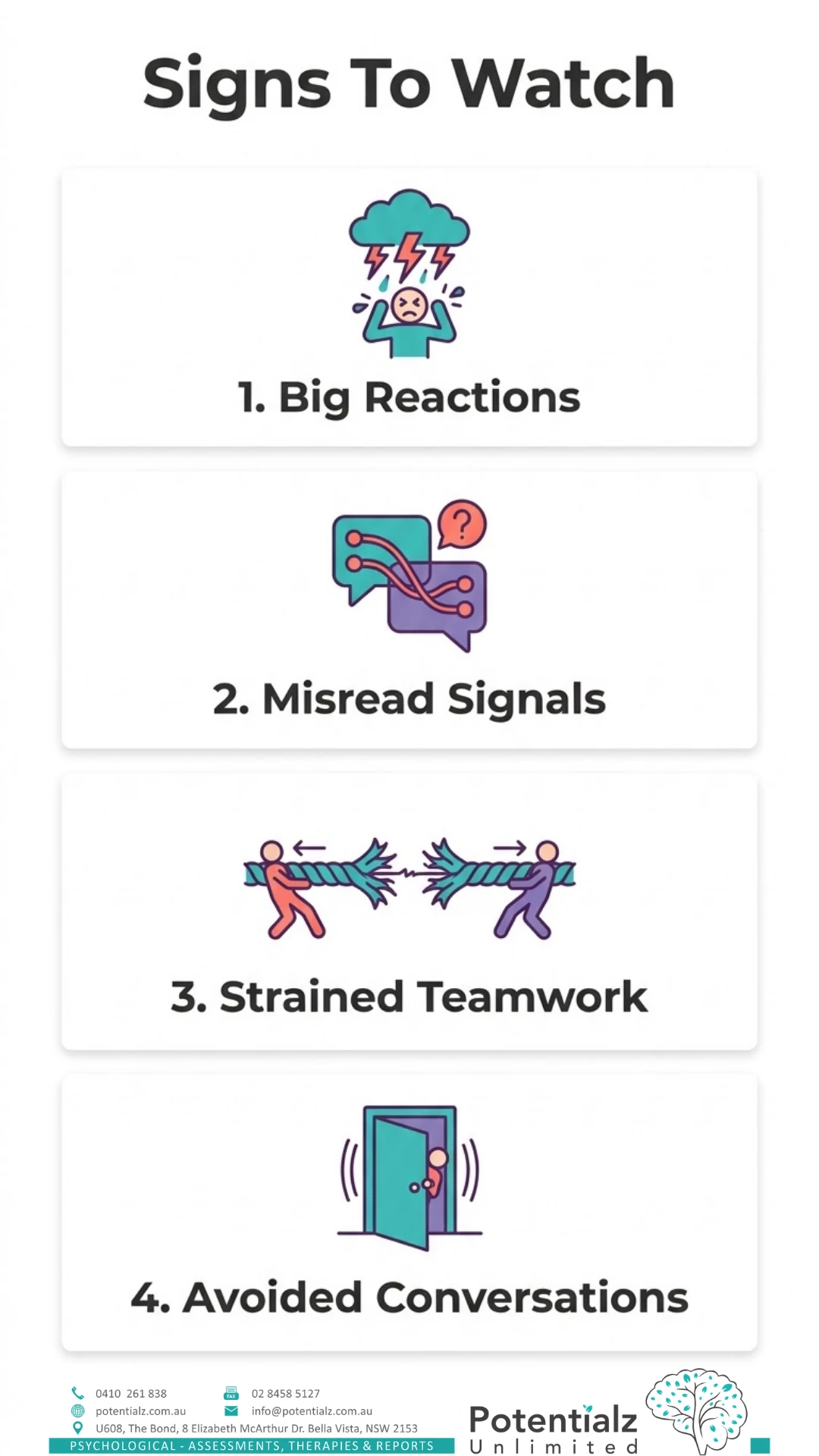
The most useful marker of lower emotional intelligence is not “being an emotional person”. Plenty of highly emotionally intelligent people feel things deeply. The marker is a pattern that repeats across a month or two:
- Big reactions that feel out of proportion to the trigger, and that you often regret within an hour.
- Misread signals — you keep landing on the wrong read of what someone meant, especially in text and email.
- Strained teamwork — projects that start smoothly then grind, with no obvious technical reason.
- Avoided conversations — the one you keep not having with your manager, your partner, your parent, your business partner.
One of these in a hard week is normal. Three of them, repeatedly, over months, is a signal that the regulation-and-relationship side of EI is worth working on directly. Our post on the signs and strategies of emotional dysregulation covers the harder end of this pattern in more depth.
Reactive vs regulated — the gap that EI lives in
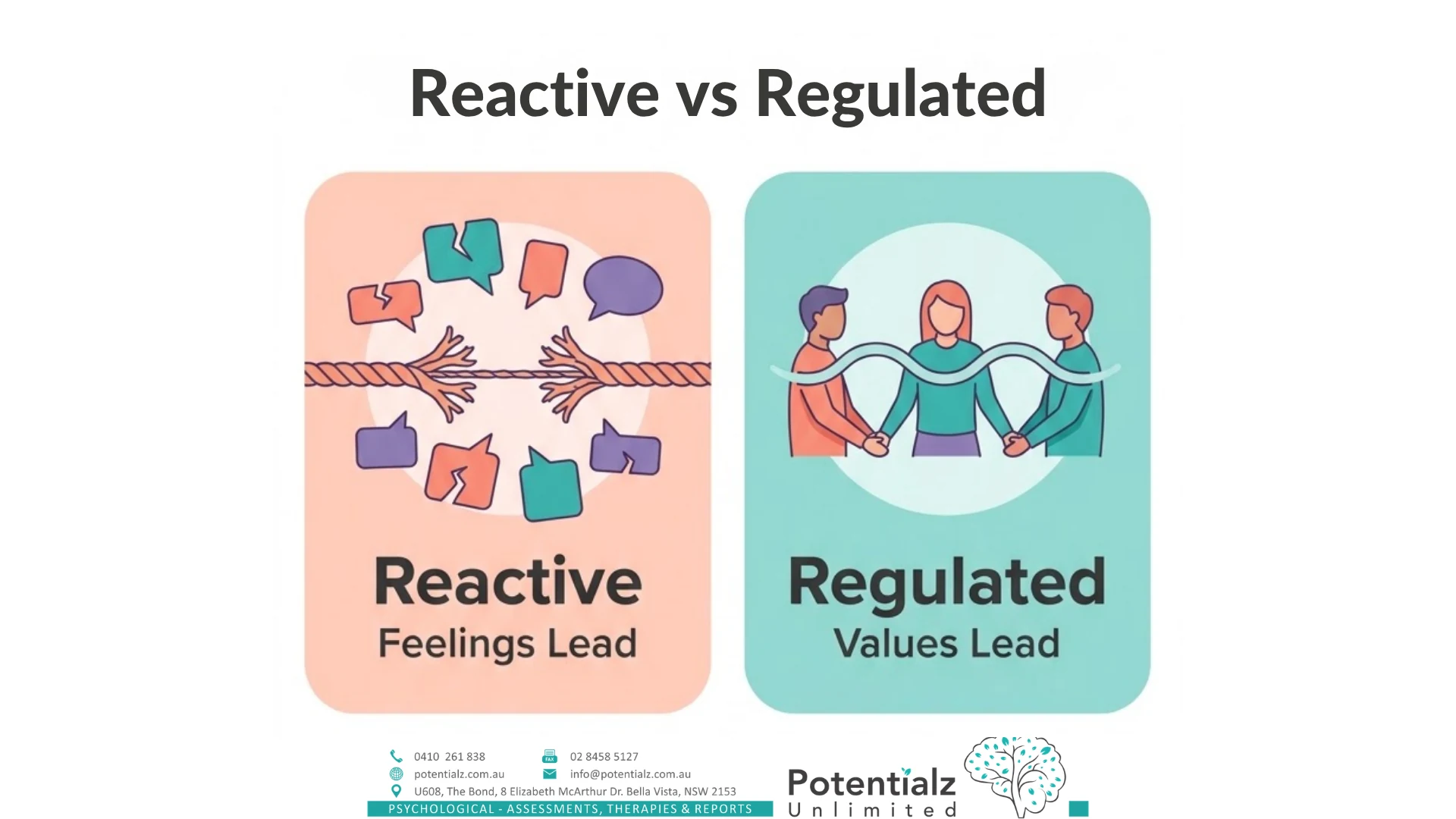
Here is the single most useful frame we offer adults in therapy around emotional intelligence.
Every response you give — in a meeting, in a conversation at home, in a reply you type — starts in the same place: a feeling. The feeling arrives before you have a chance to pick it.
The question is what leads next.
- In reactive responding, the feeling leads. The reply is already out before the slower, more considered part of you catches up.
- In regulated responding, your values lead. The feeling is still there — you noticed it, you honoured it — but what shapes the response is who you want to be in this relationship, this team, this room.
Regulation is not suppression. Suppression says “I am not having this feeling.” Regulation says “I am having this feeling, I know what matters more to me than the feeling, and I am going to let that lead.” It is a much warmer position than either suppression or venting — and it is learnable at any age.
If you are reading this and wondering about anger specifically — the most consequential reactive feeling in adult life — our practical guide to managing anger constructively builds this frame out further.
A daily practice you can start this week
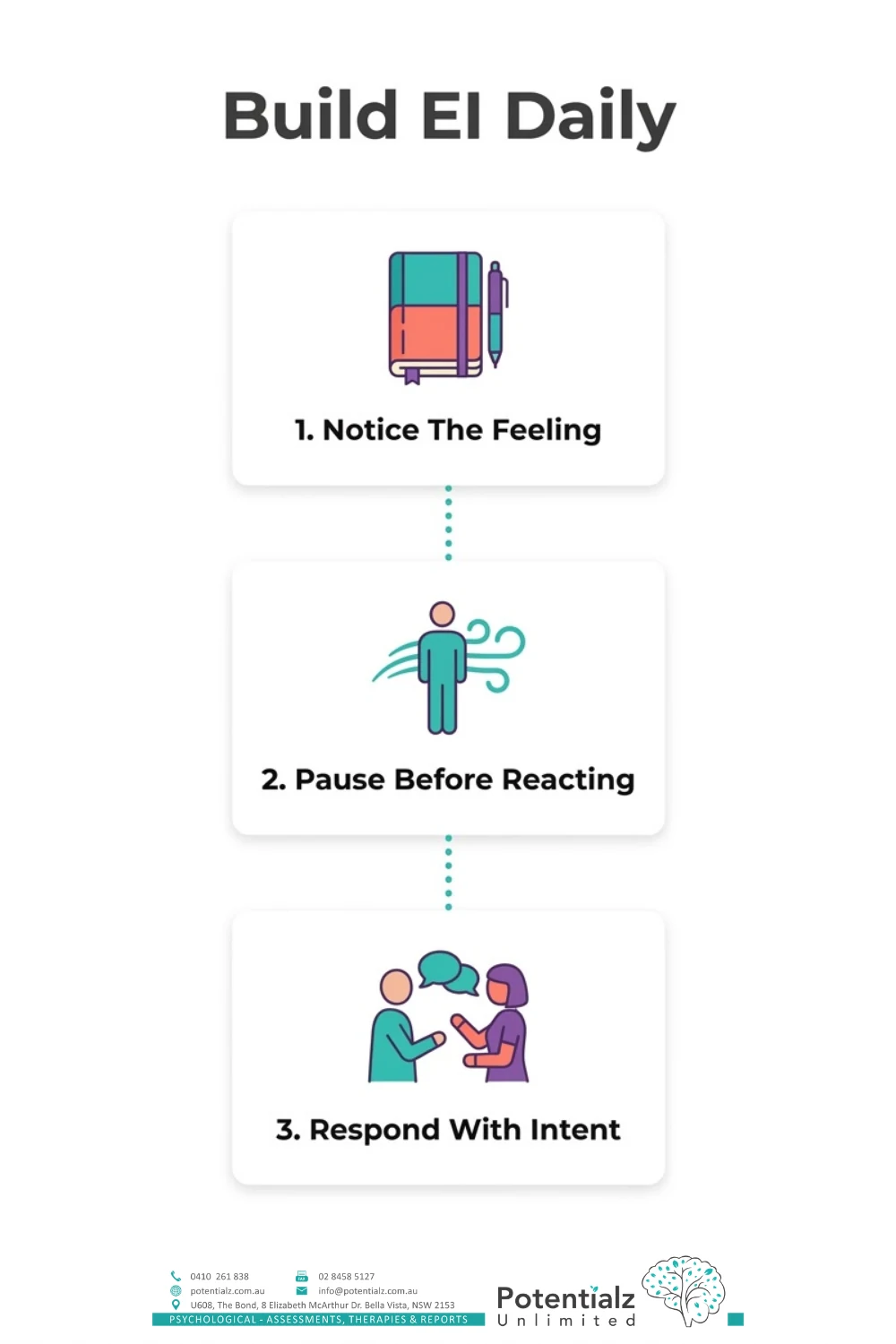
Big insights are satisfying. Small repeated habits are what actually change your emotional intelligence.
Here is the practice we most often recommend, and it fits on one line:
Notice the feeling. Pause before reacting. Respond with intent.
That is it. Three steps.
1. Notice the feeling. When something lands — an email, a comment, a look across the kitchen — name what is happening in your body before you name what is happening in the situation. Tight chest. Hot cheeks. Jaw. Breath caught high. You do not need an emotion word yet; the body is honest. If you want a longer-form version, our note on the power of journaling for mental health is a useful add-on.
2. Pause before reacting. The pause does not have to be long. One breath is often enough. The pause is not for stuffing the feeling — it is for letting the slower part of you arrive. If you can, hold the reply draft, step away from the kitchen, say “give me a minute” out loud. The pause is what makes everything downstream possible. Our grounding techniques primer offers specific tools when the pause is hard to find.
3. Respond with intent. Ask yourself the one question that saves the most adult relationships: what do I want to be true in an hour’s time about who I was just now? Then respond in a way that lines up with that answer. Not perfectly. Just in that direction.
Done once, this practice feels awkward. Done daily for six weeks, it starts to feel like you — because, cumulatively, it becomes you.
When to consider seeing a psychologist
Emotional intelligence can be grown through books, podcasts, and attention. For many adults, that is enough.
For some adults, the pattern is sticky. The reactive response wins most of the time, the pause will not come, the avoided conversations keep piling up, and the strain in a key relationship — a marriage, a working partnership, a parent — is getting worse rather than better. If that is where you are, therapy is designed exactly for this.
The reasons adults book in with us in the Hills District around EI tend to cluster:
- A relationship we care about is suffering and we can see our own role but cannot change it alone.
- A workplace situation keeps triggering reactions that are costing us professionally.
- A pattern we recognised in a parent is now showing up in how we parent, and we want it to stop here.
- We know we are managing distress in ways that are hurting us or the people close to us.
Any of those is reason enough. You do not need to be in crisis to ask for help building a capacity you want more of. Our guide to finding the right psychologist in Bella Vista walks through what to look for.
Three next steps
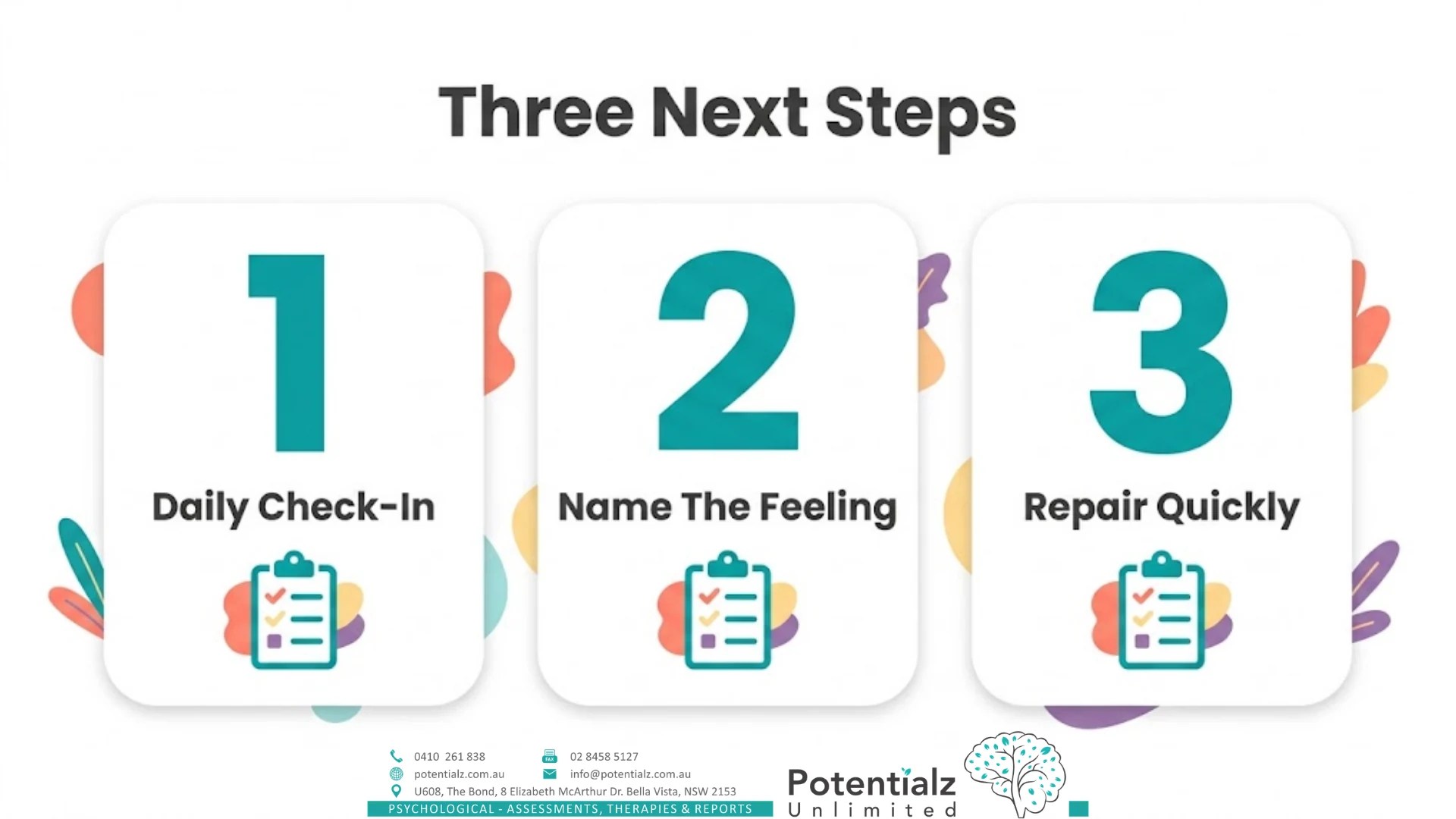
- Daily check-in. Twice a day — mid-morning and before you walk back into the house — take ten seconds to notice what you are actually feeling.
- Name the feeling. Out loud or in a note on your phone. “I’m frustrated.” “I’m anxious.” “I’m actually relieved.” The naming is where regulation begins.
- Repair quickly. When you do react in a way that doesn’t match the person you want to be, repair small and repair soon. Not big apologies — small ones, close in time. Repair is the single most powerful EI habit in long relationships.
Frequently asked questions
Can adults really grow their emotional intelligence, or is it fixed by a certain age?
Yes, adults can grow their emotional intelligence throughout life. The capacities involved — attentional control, interoception, perspective-taking, response flexibility — remain neurally plastic across adulthood. What changes with age is that habit grooves are deeper, so the deliberate practice has to be a bit more consistent to overwrite them. The ceiling is not fixed.
Is emotional intelligence the same as being nice?
No. Being nice can live alongside low self-awareness and avoided conversations. Emotional intelligence often means saying the harder true thing with care — not softer, more honest. Highly emotionally intelligent people are warm and direct; “nice” people are often warm and indirect.
How long does it take to notice a change?
Most adults who commit to the daily three-step practice (notice, pause, respond) notice a change in their own reactivity within three to six weeks, and a change in the people around them within two to three months. Relationships lag the inner change — your partner needs time to update their forecast of how you will react.
Do I need therapy, or is this something I can do myself?
Both work. Many adults grow EI on their own with reading, journalling and deliberate practice. Therapy becomes useful when the pattern is sticky — when the pause will not come, the same reactive response keeps winning, or a key relationship is deteriorating despite your effort. A psychologist does not teach you to feel differently; they help you build the pause.
What is the relationship between EI and anxiety or depression?
Lower EI is a risk factor for anxiety and depression, and anxiety and depression make EI harder in the moment. The two are linked but not the same. If you are navigating anxiety or depression, our post on cognitive behavioural therapy for anxiety and depression is the better starting point; EI work sits well alongside it.
If this post resonated and you want to work on your emotional intelligence with a psychologist in the Hills District, we see adults across Bella Vista, Castle Hill, Baulkham Hills and Norwest at Potentialz Unlimited — book a first conversation and we will take it from there.
Knowledge Check Quiz
Test what you have just read. Choose your answer for each question, then submit to reveal the answers and your score.
Need Professional Support?
If you're experiencing mental health concerns, our team is here to help.