Key Takeaways
- The “midlife crisis” framing is dated. A more useful frame is midlife transition — an ordinary life passage with meaningful psychological work to do.
- Four transitions commonly arrive at midlife, often in overlapping waves: career shift, empty nest, relationship change, and health awakening.
- The reliable three-step pattern for moving through any midlife transition is acknowledge → orient → step forward.
- Counselling at midlife is less about fixing a problem and more about moving from scattered thinking to clearer direction — noise to clarity.
- Signs that counselling would help include stuck loops, loss of meaning, strained relationships and persistent fatigue over months.
- Hills District access points include GP referral under a Mental Health Treatment Plan, private counselling and psychology, and group-based support.
Something is changing. You cannot always name it precisely. The things you built your life around — a career, a parenting role, a marriage, a body you could rely on — have shifted their weight. Not in a dramatic way, usually. In a quieter way. Enough that the standard answer of “push harder” has stopped working.
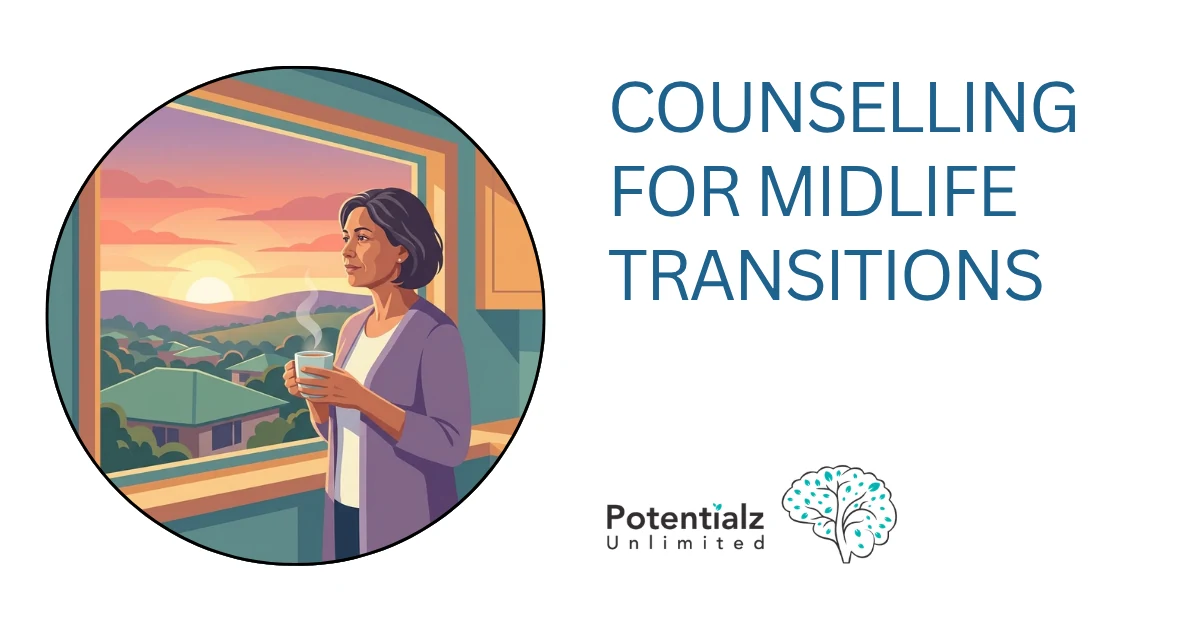
If that is somewhere in the neighbourhood of what you are navigating, this post is for you. It is not another “midlife crisis” piece — the word crisis is doing none of us any favours. The more useful word is transition, and transitions are ordinary human passages with specific psychological work to do.
From crisis to transition — a reframe
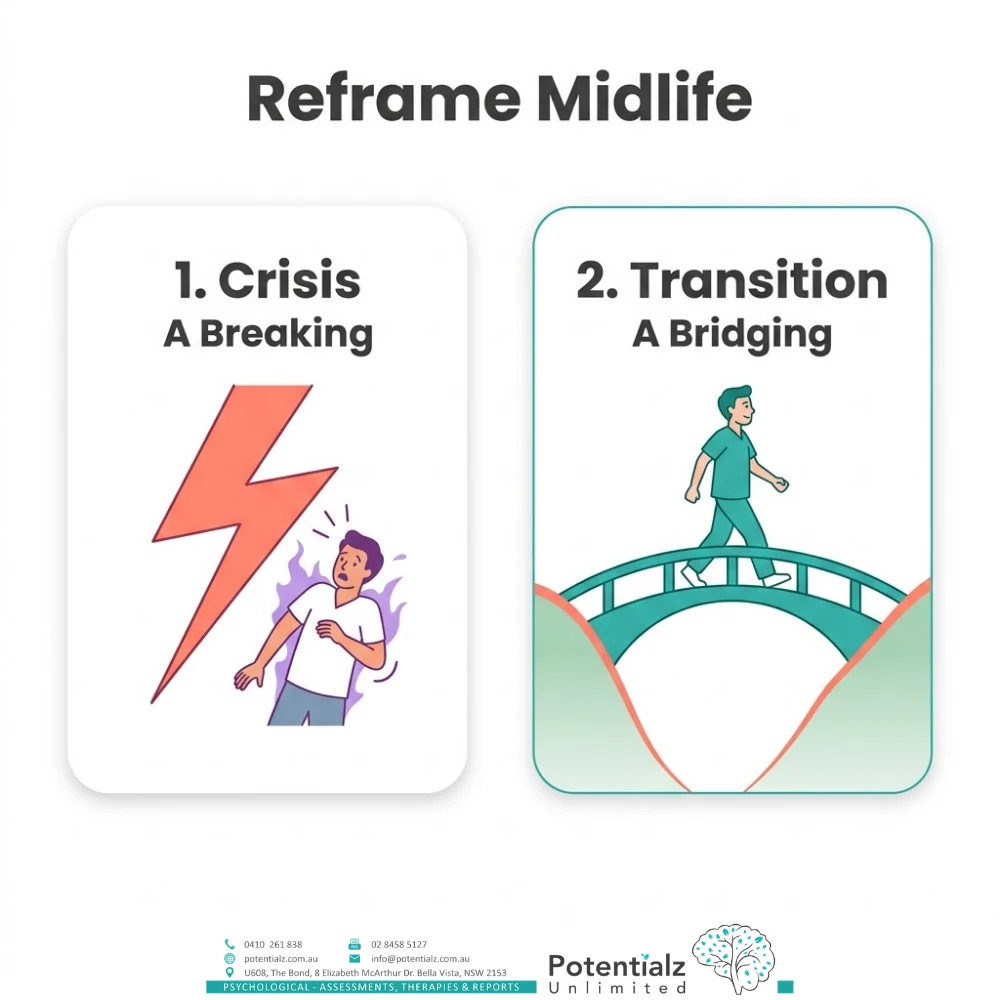
The “midlife crisis” story has a particular shape — sudden, dramatic, mildly embarrassing, resolved by a new car or a bold affair. It is a cultural narrative, not a clinical one, and it does not describe what most adults actually move through at midlife.
The more honest frame is:
- Crisis is a breaking — a sudden rupture that demands emergency response.
- Transition is a bridging — a passage between two chapters of a life, with its own interior work.
Most of what we call “midlife crisis” is, more accurately, a cluster of transitions arriving at once. Reframing them from crisis to transition changes what you are doing. You are not fixing an emergency. You are moving across a bridge — slower, steadier, with specific terrain to notice.
Four common midlife transitions
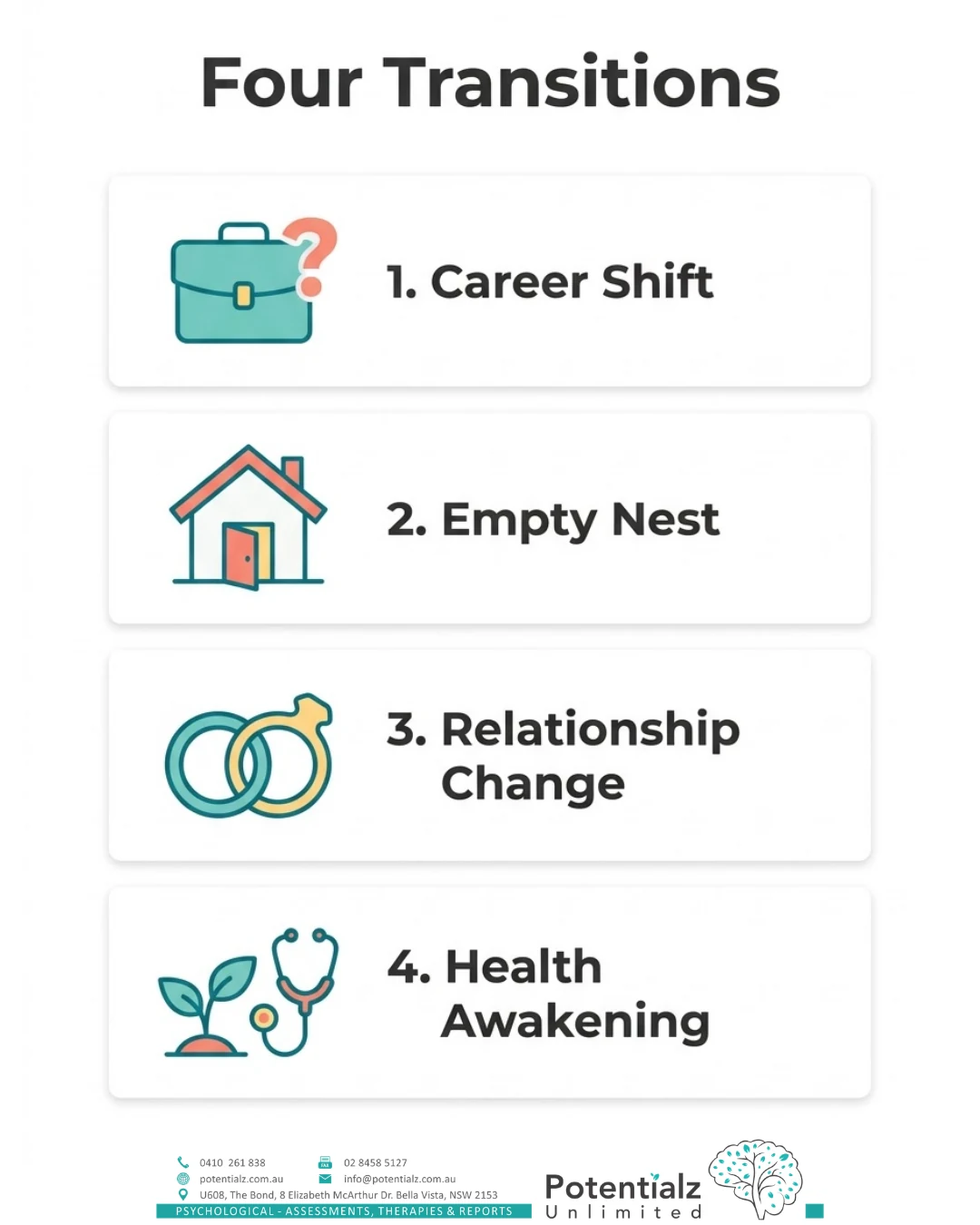
Four transitions arrive most often at midlife, and they tend to overlap:
Career shift
The job that fit at 32 can stop fitting at 48. Sometimes the person has outgrown it; sometimes the industry has shifted underneath; sometimes the trade-offs (long hours, long commute, high stress) have become visibly expensive compared to what remains. Career-shift work at midlife is rarely about ambition — it is about alignment.
Empty nest
When children leave for university, work or their own lives, a relational structure that has shaped your household for twenty years changes. The empty nest is often framed as a loss, but for many parents the deeper experience is a quieter one — a question about who you are now that one of the big roles that defined you has shrunk.
Relationship change
Long partnerships often meet their most honest conversations at midlife. The question is not usually “do we love each other” — it is “do we still want the same next chapter”. Some couples renew; some reshape; some conclude. Our couples counselling guide for the Hills District is the better starting point for partnered work specifically.
Health awakening
A diagnosis, a scare, a new chronic condition, or just the dawning awareness that the body is finite — these events often reorder a midlife adult’s priorities faster than any career coaching could. For many, this is the transition that gives the others their urgency. Our chronic illness counselling post covers the specific work when the health change is ongoing.
Signs counselling would help
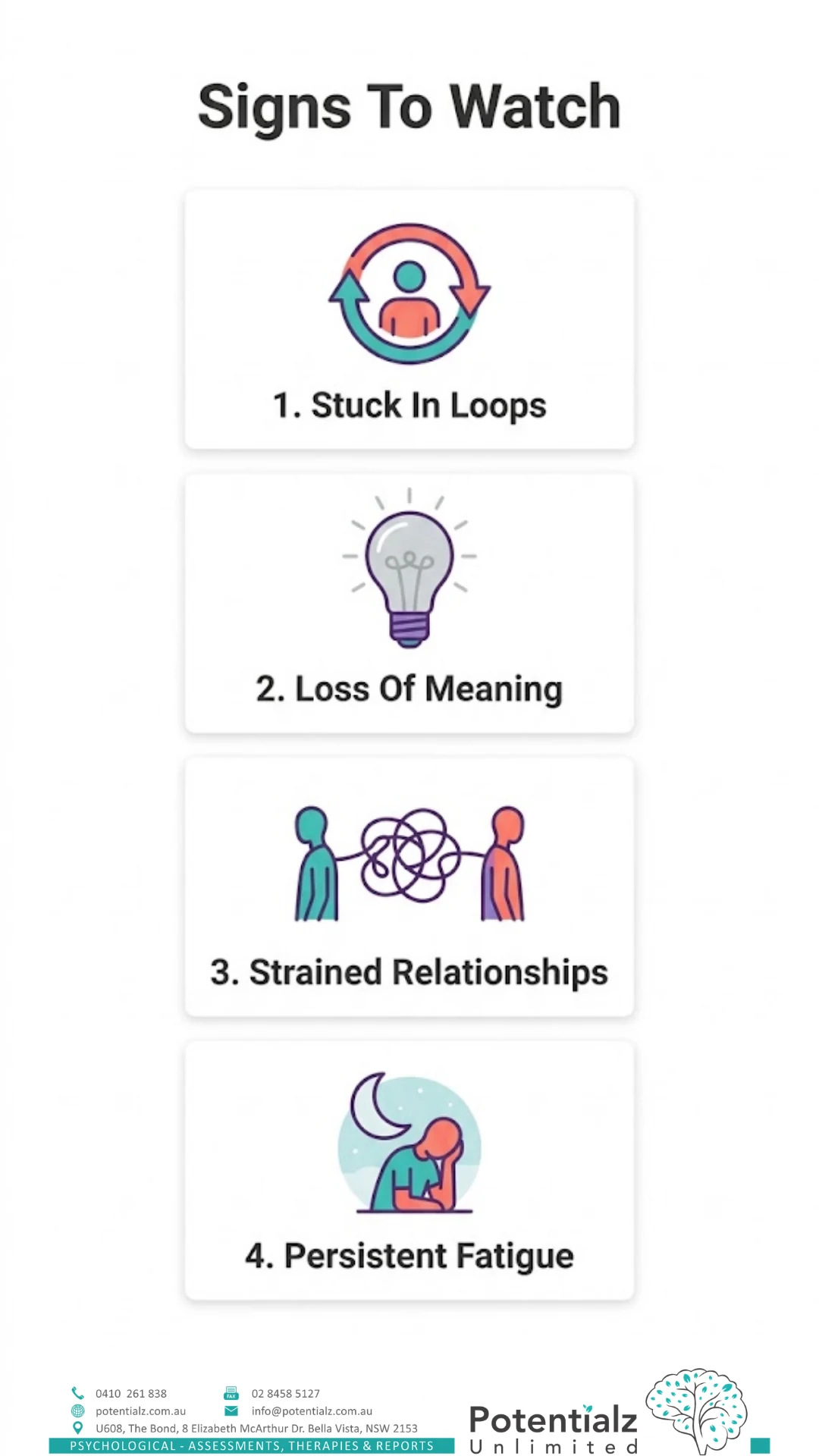
You do not need to be in crisis to work with a counsellor at midlife. The useful threshold is a persistent pattern across months, usually some combination of:
- Stuck in loops. Running the same mental argument with yourself — about a job, a relationship, a decision — without landing anywhere new.
- Loss of meaning. Things you used to find satisfying have gone flat. Not depression necessarily; a quieter dimming that is still worth attending to.
- Strained relationships. A partner, an adult child, a close friend, or your relationship with your own parents feels harder than it used to, and you can’t quite trace why.
- Persistent fatigue. The energy you used to find for things has thinned, and sleep is not fixing it.
One of these in a hard season is normal. Three of them, repeatedly, over months, is worth looking into. If what you are describing to yourself is closer to depression, our post on cognitive behavioural therapy for anxiety and depression is the better first read.
The three-step pattern
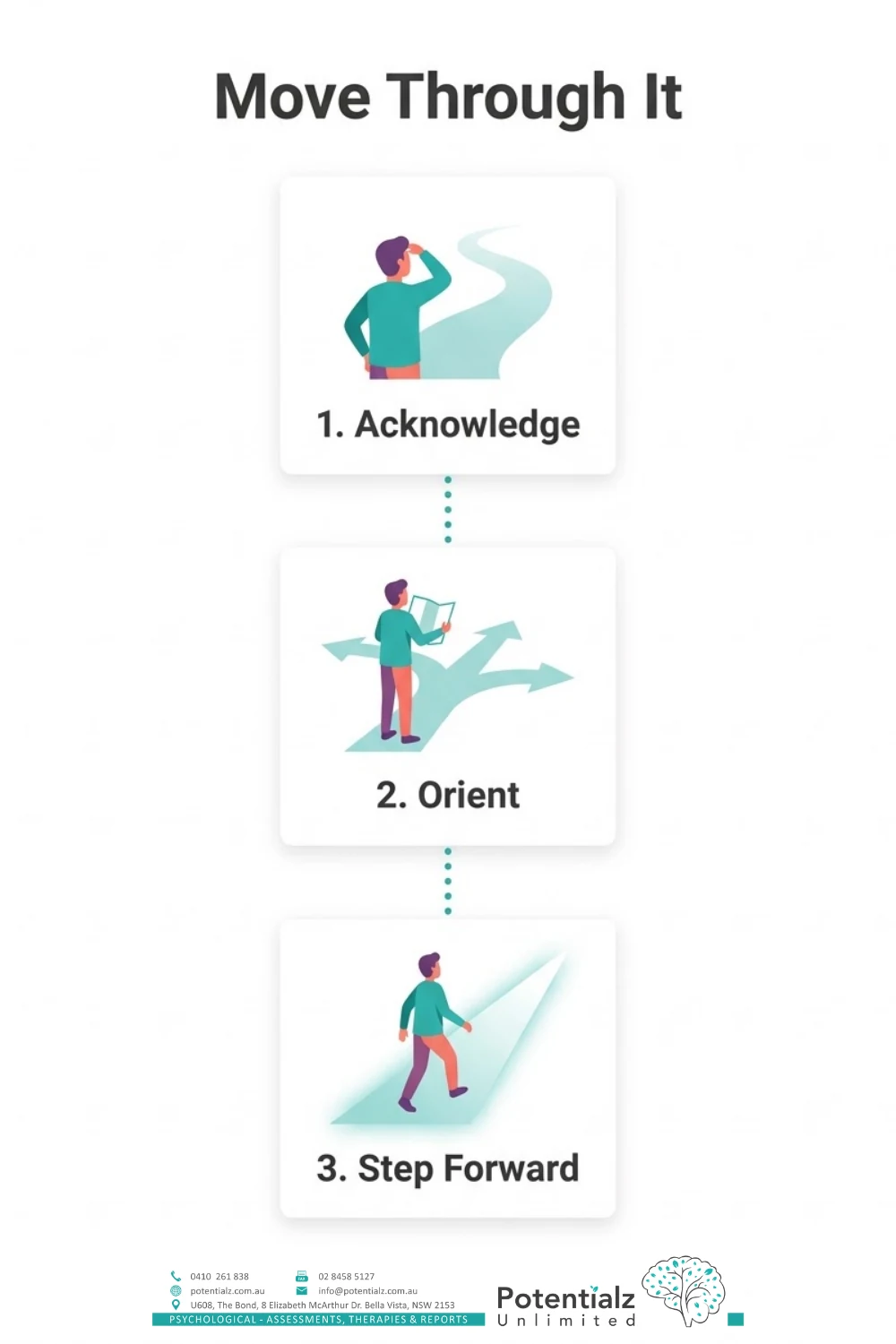
Across many midlife transitions, the same three-step pattern tends to carry people through. It is slower than our culture would like, and it is the pattern that actually works.
1. Acknowledge
The transition is real. The chapter that is ending is really ending — not fully, not forever, but it has shifted. Acknowledgement is not resignation; it is honesty. For many midlife adults, the stuck-ness comes from arguing with the fact of the transition itself. Acknowledging what is actually happening is the first act of movement.
2. Orient
Where are you now? What is the terrain of this chapter? What do you want to be true about the next five years that was not true about the last five? The orient step is where values re-emerge from the noise. Narrative therapy sits well here — our narrative therapy post covers the modality, which is a natural fit for life-chapter work.
3. Step forward
One concrete step, in the direction orientation showed you. Not a grand plan. Not a life overhaul. One step small enough that you can actually take it this fortnight. The next step reveals itself after the first — in a way that no amount of advance planning quite can.
Noise vs clarity — what counselling offers at midlife
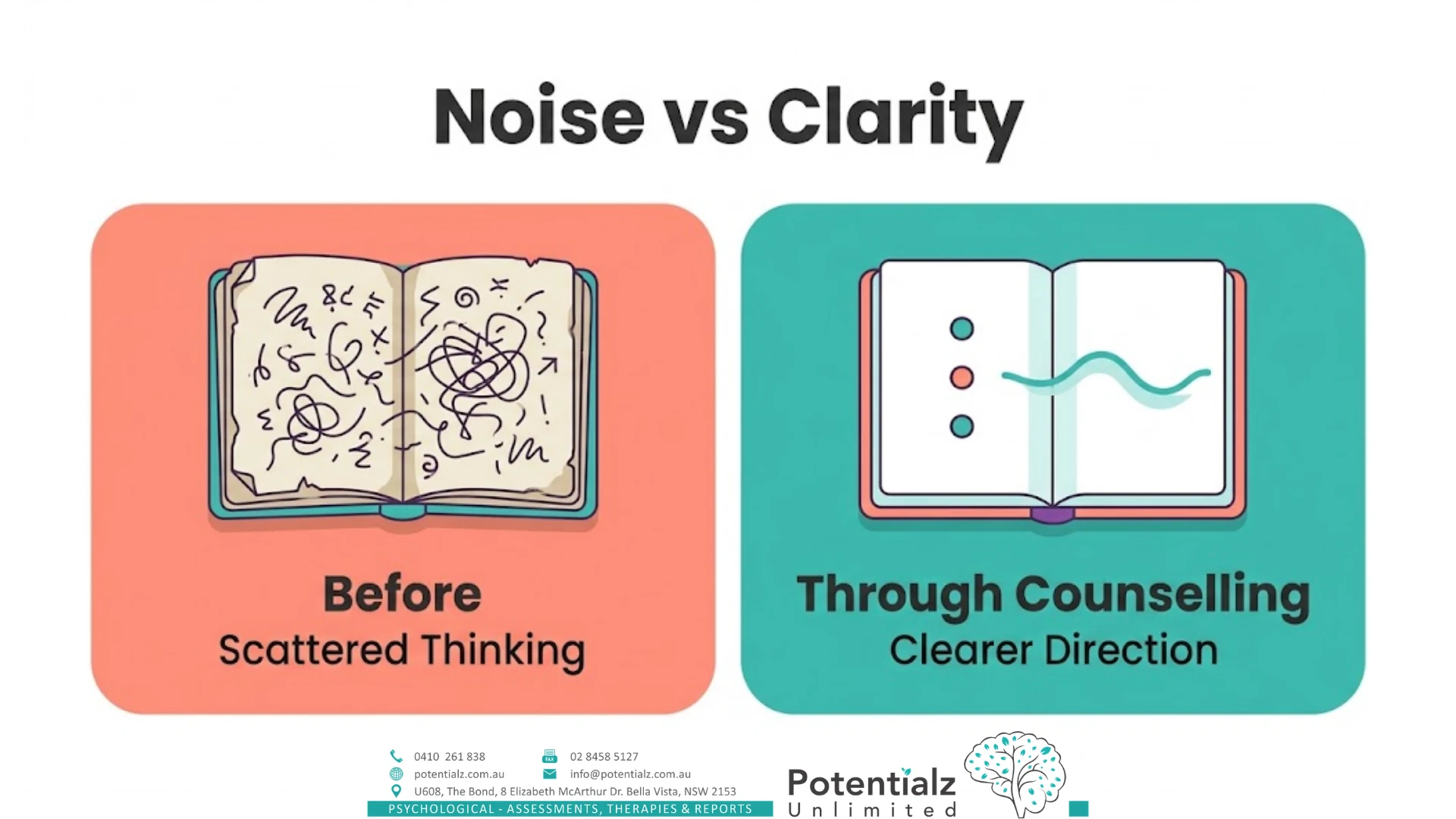
Counselling at midlife is often not about fixing a specific symptom. It is about moving from scattered to clear.
Many midlife adults arrive carrying a notebook of competing thoughts — about the job, the relationship, the parents’ care, the kids, the health, the retirement arithmetic, the question of whether any of it is right. The work of counselling is not to add more thoughts. It is to help the thinking settle into a shape where values can be seen clearly and acted on.
That shift — from noise to clarity — is often what people describe when they say “therapy changed my life at midlife”. It is not that the circumstances changed. It is that the thinking about the circumstances changed, and the actions that followed were different.
Our post on self-compassion for mental well-being covers one of the most reliably useful tools in this clarity work — self-compassion makes acknowledgement possible without self-attack.
When to involve others
- Partner. If your transition is reshaping a relationship, a few joint sessions after some individual work often integrates the change well. Our couples counselling post covers the format.
- Family. Adult children, aging parents, and siblings often become more present in midlife — our family counselling post covers the terrain when family dynamics are themselves the transition.
- GP. For fatigue, sleep, mood or health-related transitions, your GP is a useful first stop and can prepare a Mental Health Treatment Plan where appropriate.
Three next steps
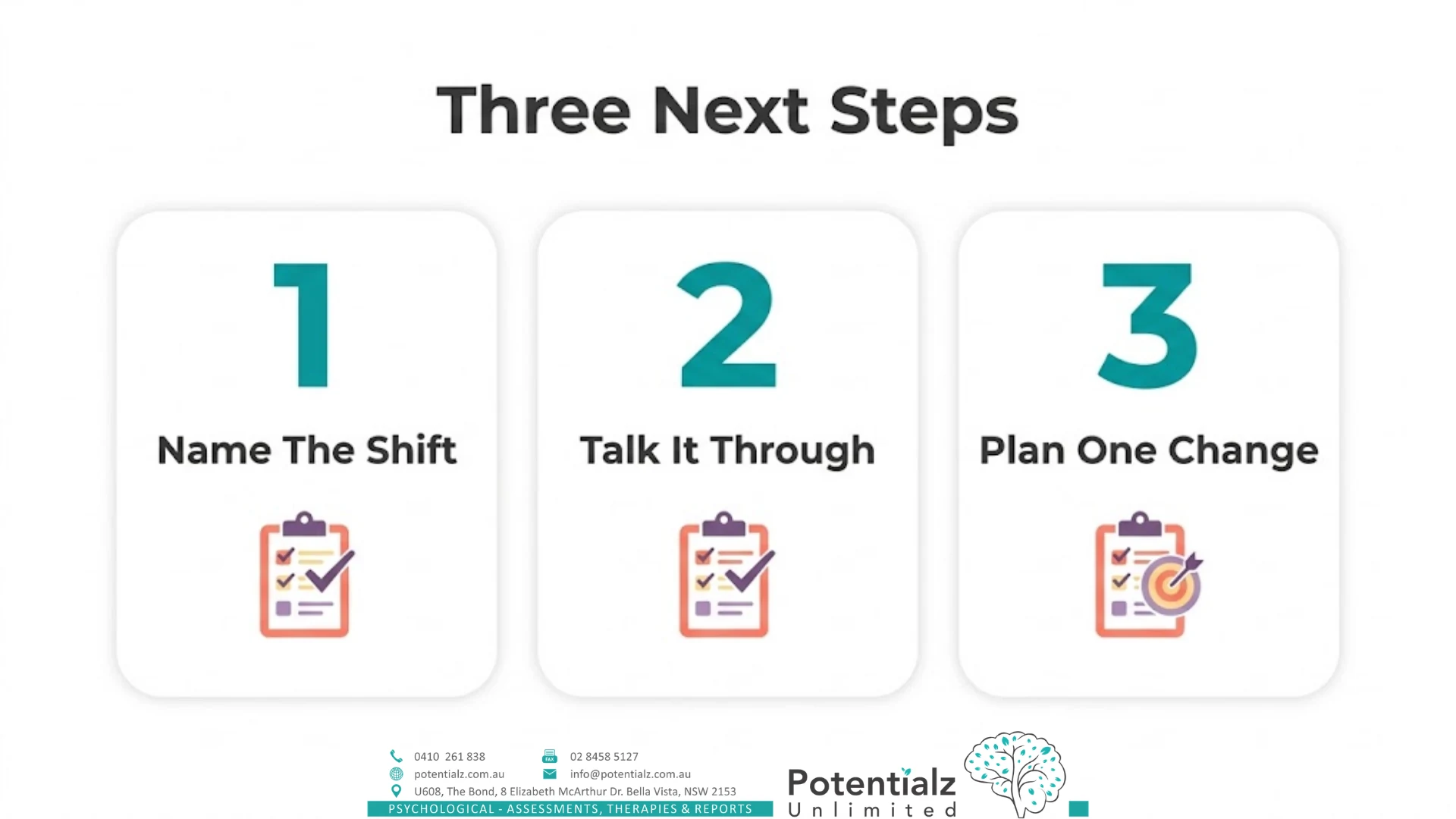
- Name the shift. Write down the single sentence that most honestly describes what is changing. Not a problem statement — a transition statement. “My job has stopped fitting.” “My role as a parent is reshaping.” “My marriage needs an honest conversation.”
- Talk it through. Once, properly, with someone whose only job is to listen well. That might be a counsellor, a trusted friend who can keep confidence, or a thoughtful GP conversation.
- Plan one change. Small, concrete, this fortnight. Not the five-year plan. The next real step.
Frequently asked questions
Is a midlife crisis the same as midlife depression?
No. A transition involves real psychological work but is not a clinical condition. Midlife depression is a diagnosable mood disorder that may coincide with transitions and benefits from specific treatment (including CBT). The two can co-occur, and distinguishing them is part of a good counselling intake.
How long does midlife counselling usually take?
Most midlife transition work settles in a block of 8 to 16 sessions, often across a season. Shorter work (4–6 sessions) is reasonable for a focused question (e.g. “should I change careers”). Longer work makes sense when transitions are compounding or when earlier life-chapter work surfaces.
Can I do this on my own without counselling?
Many adults do. Reflective practices — journalling, long walks, honest conversations with a few trusted people, reading — carry a lot of transition work. Counselling becomes useful when the thinking will not settle, when relationships are showing strain, or when the fatigue has crossed into something that is affecting daily function.
Is counselling different from coaching at midlife?
Yes. Coaching is forward-focused and goal-oriented; counselling attends to the full psychological picture, including grief, meaning, identity, and relational patterns. For many midlife transitions, counselling is the better fit — but good practitioners know which questions belong where, and will say so.
What if the transition involves my health?
If a health change is part of the picture, our counselling for chronic illness and invisible disability post is the better starting point, as the terrain is specific.
If you are navigating a midlife transition and want to work with a counsellor in the Hills District, Potentialz Unlimited sees adults from our Bella Vista rooms and by telehealth. The reaching-out is the first real step — and in our experience, it is almost always the right one.
Knowledge Check Quiz
Test what you have just read. Choose your answer for each question, then submit to reveal the answers and your score.
Need Professional Support?
If you're experiencing mental health concerns, our team is here to help.