Key Takeaways
- The “baby blues” (days 3–5 after birth, affecting up to 80% of mothers) is a brief, self-resolving hormonal response — it is not postnatal depression.
- Postnatal Depression (PND) is a clinical condition affecting up to 1 in 5 new mothers, and in some populations the rates are significantly higher.
- PND symptoms include persistent low mood, difficulty bonding with baby, intrusive fears, feelings of guilt or inadequacy, and sleep disturbance beyond normal newborn demands.
- PND is caused by a combination of hormonal, biological, psychological, and social factors — it is not a personal failure.
- Perinatal anxiety often co-occurs with PND and is sometimes mistaken for it — both require treatment.
- First-line treatment is psychological, particularly CBT — along with psychoeducation, partner support, and peer support.
- Thoughts of harming yourself or your baby require urgent help — contact your GP, Lifeline (13 11 14), or go to your nearest emergency department.
- Medicare and Gidget Foundation both provide pathways to funded psychological treatment. WorkCover may apply in some cases.
The First Months Should Feel Different From This
Many of the mothers our psychologists see at Potentialz Unlimited had a version of the same expectation before their baby arrived: that new parenthood would be hard and tiring, but also, essentially, joyful. That the love would override the difficulty. That they would feel, at some fundamental level, like themselves — just with a baby.
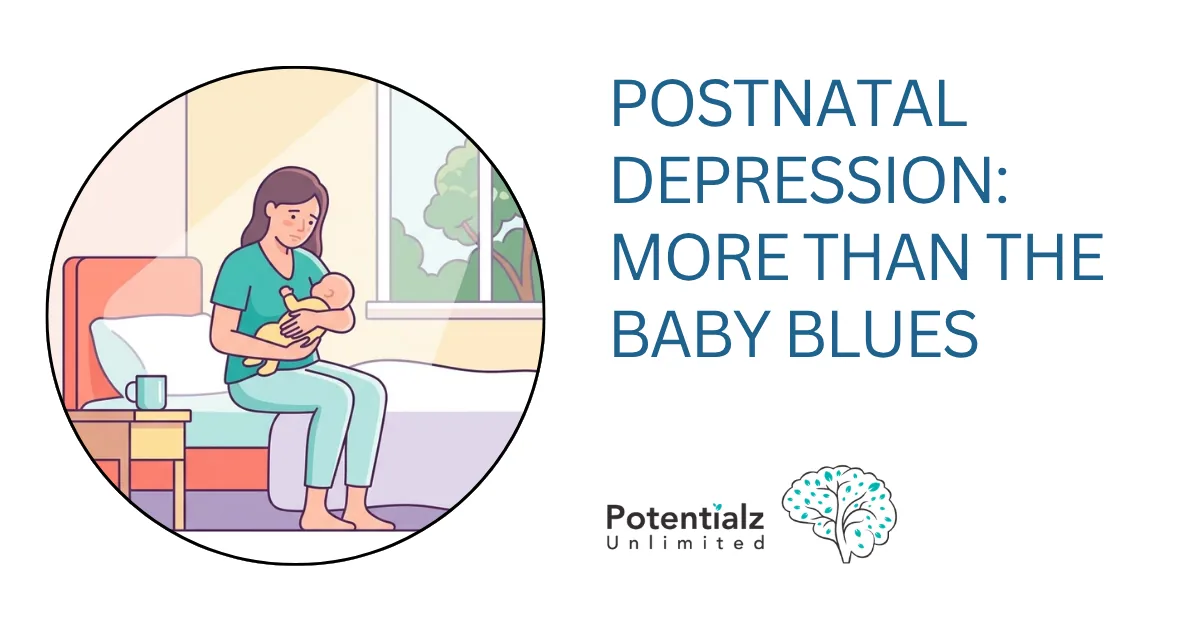
What postnatal depression looks like, when it arrives, is almost the opposite of that expectation. The baby is there, often well and thriving, and the mother finds herself feeling profoundly low, disconnected, exhausted in a way that sleep does not fix, plagued by fears she cannot voice aloud, wondering if something is permanently wrong with her — or if she has made a terrible mistake. And then, over the top of all of that, the guilt. Because she is supposed to be grateful. She is supposed to love this. She is not supposed to feel this way.
Let us say this plainly: postnatal depression is a clinical condition. It is not a moral failure. It is not evidence that you are a bad mother. It is not something to push through alone. It is a recognised, treatable condition, and with the right psychological support, most women recover.
At Potentialz Unlimited, perinatal mental health is an area of specific clinical focus. Sushama Sathe, one of our Registered Psychologists, has specialised in perinatal mental health throughout her career, including a period working with the Gidget Foundation — one of Australia’s leading perinatal mental health organisations. Our psychologists have supported many women who came to us at their lowest and left with their lives, their sense of themselves, and their connection to their babies restored.
This post is written for them, and for every new parent who suspects they might be in that place — and needs to be told clearly what is happening and what to do.
The Baby Blues Versus Postnatal Depression: An Important Distinction
Before describing postnatal depression, it helps to distinguish it clearly from something much more common and less serious: the “baby blues.”
The baby blues affect up to 80% of new mothers in the first few days after birth, most commonly peaking around day three to five. They involve tearfulness, emotional fragility, mood swings, irritability, and a sense of being overwhelmed that typically arrives suddenly and feels disproportionate to any specific trigger. The underlying cause is primarily hormonal: the dramatic, rapid drop in oestrogen and progesterone that follows delivery, combined with the physical recovery from birth and the initial sleep disruption of the newborn period.
The critical distinction is duration and severity. Baby blues are self-resolving — they typically improve significantly within 10–14 days without any specific treatment, as the body’s hormonal system restabilises and new parents begin to find their feet. They are uncomfortable and distressing, but they are not pathological.
Postnatal depression does not resolve on its own within a fortnight. It persists. It deepens. It interferes significantly with the mother’s ability to function, to care for herself and her baby, and to engage with her relationships. That persistence and functional impact is what distinguishes it clinically.
If you are two weeks postpartum and the emotional fragility and overwhelm of the first days has not begun to ease — if anything, it is getting worse — that is not baby blues. That warrants clinical attention.
What Postnatal Depression Actually Looks Like
PND does not always look like what people imagine. The popular image is a mother who cannot get out of bed, who is clearly weeping and visibly distressed. That does happen. But PND also presents as:
- A persistent flatness or emotional numbness — not dramatic crying but an inability to feel much at all, including the joy in the baby that everyone around you seems to feel effortlessly.
- Difficulty bonding with the baby — going through the motions of care competently but without a felt sense of connection, and then experiencing enormous guilt about this.
- Intrusive thoughts and fears — persistent, distressing thoughts about something terrible happening to the baby, or about accidentally or deliberately harming the baby. These thoughts are egodystonic — they horrify the person having them — and are very different from the genuine intent of a mother who wants to harm her baby. Intrusive thoughts of this kind are a recognised symptom of PND and perinatal OCD, and are far more common than most mothers know.
- Pervasive guilt and inadequacy — a relentless internal narrative that she is not a good enough mother, that she is doing everything wrong, that the baby would be better off with someone else.
- Anxiety and hypervigilance — constantly checking the baby is breathing, being unable to leave the baby with anyone, catastrophising about every small change in the baby’s behaviour.
- Exhaustion that sleep does not repair — different from the normal sleep deprivation of new parenthood; a bone-deep depletion that does not improve even on the nights when the baby sleeps.
- Withdrawal from relationships — difficulty connecting with the partner, friends, or family; a sense of being behind glass, unable to reach or be reached.
- Changes in appetite — either not eating or eating without any pleasure or awareness.
What matters most is persistence, severity, and functional impact. A bad day — or several bad days — is a normal part of new parenthood. When the difficulties are present most of the time, are getting worse rather than better, and are interfering with your ability to function and care for yourself and your baby, that is the clinical signal that warrants professional assessment.
Who Gets Postnatal Depression? Understanding the Risk Factors
PND affects up to 1 in 5 new mothers in Australia, and the rates are higher in some populations. In some studies of CALD (culturally and linguistically diverse) communities — including South Asian and Middle Eastern backgrounds — rates of up to 50–60% have been reported, reflecting additional stressors including social isolation, distance from extended family, and lack of community support. This is a pattern our psychologists see consistently across Western Sydney.
Understanding the risk factors is important — not to create anxiety for women in those categories, but because awareness allows for earlier identification and earlier support.
Hormonal and biological factors: The dramatic hormonal changes after birth — the rapid drop in oestrogen and progesterone — are the immediate physiological trigger. Some women appear more biologically sensitive to these hormonal fluctuations, particularly those with a history of premenstrual dysphoric disorder (PMDD) or who experienced mood changes on hormonal contraceptives.
Personal history of depression or anxiety: This is the single most consistent risk factor in the research literature. A woman who has experienced depression or anxiety before pregnancy has a significantly elevated risk of PND. A history of perinatal anxiety or depression in a previous pregnancy also increases risk.
Difficult birth experience: Traumatic birth — emergency caesarean, long labour, instrumental delivery, birth complications, or a subjective experience of loss of control or inadequate support — is a recognised risk factor and can itself be a source of birth-related trauma or PTSD alongside PND.
Sleep deprivation and physical depletion: The relationship between sleep disruption and mood is well-established. The severe, sustained sleep deprivation of new parenthood is not a benign factor — it has direct effects on mood regulation, cognitive function, and emotional resilience.
Social isolation and lack of support: New parenthood in Australia — particularly in Western Sydney’s newer suburban communities — can be profoundly isolating. If a woman does not have an extended family network nearby, a supportive partner, or connections in a mother’s group or community, the isolation can deepen and accelerate the development of PND.
Identity disruption and the maternal identity shift: This is something our psychologists spend significant clinical time on, and it is often underrecognised in the clinical literature. Becoming a mother involves what researchers call a “matrescence” — a transformation of identity as profound as adolescence. The question “Who am I now?” is a real clinical presentation, and it is not a trivial one. A woman who derived a significant part of her sense of self from her professional identity, her autonomy, her relationships, or her physical capacity may find that the shift into new motherhood brings a genuine identity loss that intersects with the PND presentation.
Relationship difficulties and partner support: The transition to parenthood is one of the most stressful periods in a couple relationship. Research consistently shows that partner support is one of the most significant protective factors against PND — and that relationship conflict or partner withdrawal is a significant risk factor.
CALD background with limited community support: As noted above, women from cultural backgrounds where there are strong traditions around postpartum care (such as the Indian tradition of the “confinement period” where extended family care for the new mother) but who are living in Australia without access to that support, can experience the gap between expectation and reality as particularly distressing.
Postnatal Anxiety: Not the Same as PND — But Often Appearing Together
Perinatal anxiety deserves its own section, because it is often missed or misidentified.
Perinatal anxiety affects approximately 15–20% of new mothers. Its symptoms are distinct from PND: persistent excessive worry, physical tension, difficulty relaxing, hypervigilance about the baby’s safety, intrusive “what if” thoughts, avoidance of situations that might trigger anxiety, and sometimes panic attacks.
Crucially, anxiety and depression commonly co-occur in the perinatal period — research suggests approximately 50% of women with PND also have a significant anxiety presentation. This matters clinically because the treatment needs to address both: CBT for anxiety often requires different emphasis than CBT for depression, and missing the anxiety component can significantly limit outcomes.
What our psychologists also see in practice is that perinatal anxiety is sometimes dismissed as “normal new parent worry” — by health professionals, by partners, and by the mother herself. There is a cultural script that new mothers are supposed to be anxious about their baby, so the anxiety is not flagged as abnormal. But when that anxiety is pervasive, intrusive, and interfering with daily function, it is a clinical concern that deserves the same attention and treatment as PND.
You can read more in our guide to perinatal anxiety in pregnancy and new parenthood, and learn how evidence-based treatment works with our anxiety psychologists in Bella Vista.
What About Partners? Paternal Postnatal Depression Exists.
This deserves naming explicitly, because partners are often invisible in the perinatal mental health conversation.
Approximately 1 in 10 fathers (and a similar proportion of non-birthing partners) experiences postnatal depression. The presentation is often different from maternal PND: it may present as irritability, withdrawal, increased alcohol use, excessive work focus, or somatic complaints rather than overt sadness or tearfulness. Partners who are experiencing depression are less able to provide the support that protects against maternal PND — creating a reinforcing cycle.
Partners also often carry enormous unacknowledged anxiety about the new baby’s safety, about financial pressure, about whether they are measuring up. They may feel displaced by the mother-baby dyad, or uncertain about how to be useful.
If you are a partner reading this, please know: your mental health in this period matters too, and it is worth seeking support. The transition to parenthood can be a genuine crisis for both parents — and our psychologists work with couples, not just mothers. See our guide to paternal postnatal depression for more.
Treatment: What Works for Postnatal Depression
Psychological treatment is the first-line recommendation for mild to moderate PND in current Australian and international clinical guidelines. The evidence for CBT in perinatal depression is particularly strong — multiple meta-analyses confirm its effectiveness for both PND symptom reduction and prevention of relapse.
In CBT with our psychologists, treatment for PND involves:
- Psychoeducation: helping the mother (and, where possible, her partner) understand what PND is, why it develops, and what maintains it — this alone can be enormously relieving
- Cognitive work: identifying and challenging the relentless self-critical thoughts that characterise PND — “I’m not a good enough mother,” “I’m doing everything wrong” — and constructing more accurate, balanced perspectives
- Behavioural activation: systematically and gently re-engaging with activities that support mood, including social contact, light exercise, and activities the mother valued before the baby arrived
- Sleep hygiene and practical supports: working with the partner and support system to protect pockets of sleep, which is foundational to everything else
- Identity work: explicitly addressing the matrescence and the “who am I now?” dimension of the transition to parenthood
- Relational work: where indicated, including the partner in sessions to strengthen communication, support, and shared understanding of PND
Medication is considered in moderate to severe PND, and in consultation with the woman’s GP or psychiatrist. Several antidepressants are compatible with breastfeeding. The combination of psychological treatment and medication produces better outcomes than either alone in more severe presentations. Our psychologists always work collaboratively with the prescribing clinician.
Peer support — including mother’s groups, perinatal peer support programs, and organisations like PANDA (Perinatal Anxiety and Depression Australia) — is a valuable complement to individual psychological treatment, particularly for the social isolation component of PND.
When to Seek Urgent Help
This next point matters, so it is worth being direct.
If you are experiencing thoughts of harming yourself or harming your baby, please seek help immediately. These thoughts are a symptom of severe PND and require urgent clinical attention — not because you are dangerous, but because you deserve emergency care right now.
Do not wait for a scheduled appointment. Call your GP today and tell them what you are experiencing. Contact Lifeline on 13 11 14. Go to your nearest emergency department. Call PANDA on 1300 726 306.
The thoughts are a symptom. They are not who you are. And with the right help, they will resolve.
Also in This Series: Treatment, Support, and the Path Forward
This article focuses on recognising postnatal depression — the full symptom picture including the intrusive thoughts many mothers find hardest to talk about, risk factors, the baby blues distinction, and urgent warning signs. For a companion article covering treatment in detail — what CBT for PND involves, the impact on mother-infant bonding, pathways through Medicare and the Gidget Foundation, and what Potentialz Unlimited can offer specifically to mothers from CALD backgrounds — see:
How Potentialz Unlimited Can Help
Perinatal mental health is an area of specific clinical focus at Potentialz Unlimited. Sushama Sathe, one of our Registered Psychologists, worked with the Gidget Foundation in perinatal mental health from 2023 to 2024 and has continued to prioritise this work in practice at Potentialz Unlimited, including facilitating workshops on perinatal health and wellbeing for new parents.
Our psychologists offer thorough psychological assessment for postnatal depression and anxiety, and evidence-based psychological treatment using CBT as the primary modality. They work with the whole family where that is appropriate — including partners — and maintain communication with your GP, midwife, or maternal and child health nurse to ensure coordinated care.
Potentialz Unlimited is at Unit 608, 8 Elizabeth Macarthur Drive, Bella Vista NSW 2153, seeing clients Monday to Friday, 10am to 7pm, with Saturday and after-hours appointments available. Telehealth via phone or Zoom is available.
Medicare rebates are available with a GP Mental Health Care Plan — your GP can refer you for up to 10 psychology sessions per calendar year. The Gidget Foundation also provides a referral pathway for funded perinatal mental health care. NDIS and EAP/EPP referrals are also accepted.
You do not have to wait until things get worse. If you are not sure whether what you are experiencing is PND, please reach out. The assessment itself is useful — and early intervention produces better outcomes.
Book at live.potentialz.com.au or call 0410 261 838.
You can also read our guides to perinatal anxiety and paternal postnatal depression for further information.
References
Austin, M.-P., Highet, N., & the Expert Working Group. (2017). Mental health care in the perinatal period: Australian clinical practice guideline. Centre of Perinatal Excellence (COPE). https://www.cope.org.au
Dennis, C.-L., & Dowswell, T. (2013). Psychosocial and psychological interventions for preventing postpartum depression. Cochrane Database of Systematic Reviews, 2013(2). https://doi.org/10.1002/14651858.CD001134.pub3
Goodman, J. H. (2019). Perinatal depression and infant mental health. Archives of Psychiatric Nursing, 33(3), 217–224. https://doi.org/10.1016/j.apnu.2019.01.010
Haga, S. M., Slinning, K., Aas, B., & Drozd, F. (2019). Perspectives on barriers to using mental health services among postpartum depressed women: A qualitative study. Birth, 46(4), 553–560. https://doi.org/10.1111/birt.12438
Muscat, T., Obst, P., Cockshaw, W., & Thorpe, K. (2014). Beliefs about infant regulation, early infant behaviors and maternal postnatal depressive symptoms. Birth, 41(2), 206–213. https://doi.org/10.1111/birt.12109
Disclaimer
Sushama Sathe is a Registered Psychologist registered with AHPRA (Psychology Board of Australia, Registration No. PSY0001370871) and a member of the Australian Psychological Society. The information in this post is general in nature and does not constitute clinical advice. Please consult a qualified health professional for your individual circumstances. If you are experiencing a mental health crisis, contact your GP, call Lifeline on 13 11 14, or go to your nearest emergency department.
Related reading
- Which therapy actually helps for postnatal depression? — an evidence-based guide to CBT, IPT and the Hills District pathway.
Crisis Resources
- Lifeline: 13 11 14 (24/7)
- Beyond Blue: 1300 22 4636
- PANDA (Perinatal Anxiety and Depression Australia): 1300 726 306
- Kids Helpline: 1800 55 1800
- MensLine Australia: 1300 78 99 78
- Emergency: 000
Knowledge Check Quiz
Test what you have just read. Choose your answer for each question, then submit to reveal the answers and your score.
Need Professional Support?
If you're experiencing mental health concerns, our team is here to help.