Key Takeaways
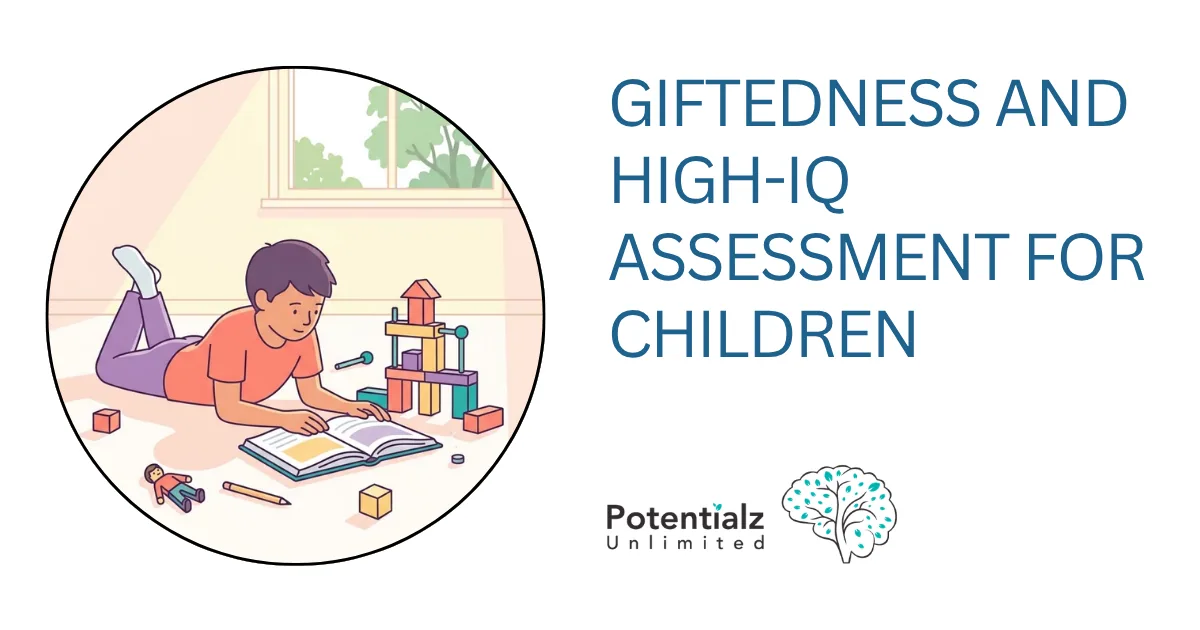
- Giftedness is not a synonym for high achievement, high effort, or a particular kind of personality. It is a specific cognitive profile — advanced reasoning, memory, and learning capacity relative to same-age peers — that shows up in a range of ways at home and at school, and that can be characterised by formal cognitive assessment. Not every gifted child needs assessment, but many benefit from it.
- The most widely used cognitive assessment for gifted children in Australia is the WISC-V (ages 6 to 16:11). For very young children the WPPSI-IV is used (ages roughly 2:6 to 7:7). For adolescents at the upper end of the WISC-V age range and beyond, the WAIS-IV or newer WAIS-5 is used. All are individually administered by a psychologist over several hours.
- The Full Scale IQ (FSIQ) is the number people ask about, but for gifted profiles the General Ability Index (GAI) is often the more meaningful summary. The GAI combines verbal comprehension and fluid/perceptual reasoning while downplaying working memory and processing speed — indices that are frequently relatively lower in gifted children and that can drag down the FSIQ without changing the underlying reasoning picture.
- Selective schools testing (the NSW Selective High Schools and Opportunity Class tests) is not the same as cognitive assessment. Those tests measure specific academic aptitudes designed to select for a particular kind of program. A cognitive assessment tells you something broader about how your child’s mind works. The two can complement each other but they are answering different questions.
- Twice-exceptional (often written “2e”) is a term for children who are both cognitively gifted and have a co-occurring condition such as ADHD, autism spectrum condition, a specific learning disorder, anxiety, or another neurodevelopmental difference. Twice-exceptional profiles are common and are often missed — because the giftedness masks the difficulty and the difficulty masks the giftedness, and the child ends up looking merely average.
- Gifted children can and do struggle. Intensity, perfectionism, existential worry, social mismatch with age peers, and boredom-driven behavioural difficulties are common experiences. Assessment is not about crowning the child; it is about understanding the child so the environment can be shaped to help them thrive.
- At Potentialz Unlimited in Bella Vista, formal cognitive assessment is delivered by Dr Gurprit Ganda, our senior Clinical Psychologist. My role as a Registered Psychologist is to help families think through whether assessment is the right next step, to support gifted children through the emotional and social side of being wired differently, and to pick up the therapy work that often accompanies a gifted profile — anxiety, perfectionism, low mood, social difficulties, and family recalibration.
- If you are wondering whether your child might be gifted, a phone conversation is a better starting point than a search engine result. Reception will help you think about whether an assessment is likely to add value, and if so what shape it should take.
Why This Post Exists
The families we speak with about giftedness are, in our experience, rarely the parents that the popular stereotype suggests. Most of them are not trying to prove their child is special. They are trying to understand a child who is puzzling them.
They describe a child who does not quite fit. A five-year-old who taught herself to read before starting school and now spends recess by herself because the age-peers do not want to talk about the things she wants to talk about. A seven-year-old who is bored at school and starting to actively hate going. A nine-year-old whose emotional intensity feels bigger than the situations that trigger it. A twelve-year-old whose report card is inexplicably ordinary despite a mind that clearly is not. A teenager who is bright and articulate but has never learnt to study because nothing was hard until it was, and now they cannot cope.
By the time these parents are asking about assessment, they have often already been dismissed at least once. By a teacher who told them all parents think their child is smart. By a family member who worries assessment will “put ideas in her head”. By their own inner voice telling them not to make a fuss. Some of them are calling because a school psychologist has raised the possibility. Some are calling because a paediatrician has. Some are calling because a friend’s child has been assessed and the description of that child sounded uncannily familiar.
This post is our honest, plain-English answer to the question they are all asking, in one form or another: should we do a cognitive assessment, what would it tell us, and if the answer is yes, then what?
At Potentialz Unlimited in Bella Vista, formal cognitive assessment is delivered by Dr Gurprit Ganda, our senior Clinical Psychologist. Alongside the assessment itself sits the work families often need just as much: thinking through whether assessment is warranted in the first place, supporting the emotional side, and picking up the therapy that frequently accompanies a gifted profile. This guide covers both.
What Giftedness Actually Is
In current use, “gifted” refers to advanced cognitive functioning relative to age-peers — measured on standardised cognitive assessments, and often defined as scoring in roughly the top 2 to 5 per cent of the population (a Full Scale IQ or General Ability Index of approximately 130 and above). Different definitions cut the line in slightly different places, and different educational systems use slightly different thresholds. The Australian Association for the Education of the Gifted and Talented uses definitions consistent with the international literature.
But even that definition, tidy as it is, does not capture the whole picture. Giftedness as it is lived is more than a score. In the clinical literature, gifted profiles tend to come with a set of accompanying features — intensity, sensitivity, asynchronous development (where cognitive age is well ahead of emotional and social age), curiosity that is genuinely insatiable, existential concerns emerging early, and a specific set of vulnerabilities alongside the strengths. Some frameworks — the theoretical work of Kazimierz Dąbrowski and later writers like Michael Piechowski — describe these as “overexcitabilities”: intellectual, imaginational, emotional, sensual, and psychomotor. That framework is not the only way to think about giftedness, but it captures something clinically real about the way many gifted children experience the world.
Giftedness is not:
- Achievement. A child can be gifted and underachieving; a child can be a diligent, achievement-oriented student who is not, in cognitive-assessment terms, gifted. The two are related but distinct.
- Precocity in one specific domain. Some children are advanced in one narrow area (early reading, mental maths, musical ability) but average or below in others. Domain-specific advanced abilities are worth noting but do not on their own constitute cognitive giftedness in the broader sense.
- A guarantee of academic success. Many gifted children struggle at school for a range of reasons: boredom, perfectionism, undiagnosed co-occurring conditions, social difficulties, mismatch between how the child learns and how the classroom teaches. Being gifted is a resource, not a solution.
- A personality style. Gifted children are as varied in personality as any other group. Some are extroverted, some are introverted. Some are anxious, some are relaxed. Some are diligent, some are chaotic. The cognitive profile does not dictate the personality.
- A moral or social superiority. This one matters. A gifted child is not a better child. They are a child with a specific cognitive profile that has both strengths and vulnerabilities, and they need care and support like any other child — sometimes more, sometimes differently.
When to Consider Assessment for Giftedness
The families who most often benefit from formal cognitive assessment fall into several patterns. Not every gifted child needs assessment, and assessment for its own sake is rarely justified. But there are situations where the information the assessment provides is genuinely useful.
When a child is visibly struggling in ways that do not add up. A child who is bright in conversation but hating school. A child whose emotional intensity is much bigger than same-age peers can hold. A child who has become disengaged, oppositional, or withdrawn at school. A child whose behavioural difficulties do not track to obvious environmental drivers.
When there are questions about educational placement. A child whose parents and teachers are wondering about grade acceleration, part-time gifted programs, subject acceleration in high school, or entry to selective schooling. Formal cognitive assessment is often required as part of these decisions.
When a co-occurring condition may be part of the picture. A child who might have ADHD, autism, a specific learning disorder, anxiety, or another neurodevelopmental difference alongside apparent cognitive strength. Twice-exceptional profiles are common and easily missed without assessment. There is more on the ADHD-vs-autism assessment question in ADHD vs Autism Assessment: Key Differences.
When a child is asking their own questions. An older child who is starting to notice they are different, who is asking whether something is wrong with them, who is trying to make sense of why they think about things nobody around them thinks about, may benefit substantially from having a proper cognitive profile as part of their self-understanding.
When the school is asking for evidence. Many schools now require formal external assessment to support decisions about learning enrichment, extension programs, or in-class differentiation for gifted students.
When there is a family history of giftedness that comes with lived-experience knowledge of what happens when it is not recognised. Some parents come in because they themselves were gifted-and-missed as children and are determined not to let their child go through the same slow disillusionment with school that they did.
When the child is very intense at home in ways that are causing family strain. Extreme sensitivity, moral rigidity, existential anxiety, difficulty tolerating perceived injustice, exhausting curiosity — these patterns are common in gifted children and can be genuinely hard on the family. A proper cognitive profile can reframe how the family understands what is going on.
And situations where assessment is probably not necessary right now:
- A young child (under about six) whose obvious strengths are being well-catered-for at home and preschool with no visible difficulties. Wait and see is often reasonable.
- A child whose strengths are being noticed and supported by the school without a formal assessment being required.
- A family where the primary motivation is comparison (“I want to know how she compares to her cousin”). Assessment is not the right tool for that question.
- A child in significant emotional distress where stabilisation and therapy should come first and assessment can be revisited later.
The WISC-V, the WPPSI, and Which Test at Which Age
The cognitive assessment used depends on age.
Ages 2 years 6 months to 7 years 7 months — the WPPSI-IV (Wechsler Preschool and Primary Scale of Intelligence, Fourth Edition). The subtests are adapted for young children (shorter, more visual, more play-like) and the norms are appropriate for the preschool and early school age range.
Ages 6 years 0 months to 16 years 11 months — the WISC-V (Wechsler Intelligence Scale for Children, Fifth Edition). This is the workhorse of gifted assessment in the school-age years. The WISC-V produces five index scores (Verbal Comprehension, Visual Spatial, Fluid Reasoning, Working Memory, Processing Speed) plus a Full Scale IQ, and various composite scores including the General Ability Index (GAI), which we will come back to.
Ages 16 years 0 months and up — the WAIS-IV (Wechsler Adult Intelligence Scale, Fourth Edition), or increasingly the WAIS-5 as it is progressively adopted. In the 16:00–16:11 overlap window, the clinician will choose based on the specific referral question. There is more on adult cognitive assessment in WAIS Adult IQ and Cognitive Assessment in Bella Vista.
Each of these tests is individually administered — one child, one clinician, in a quiet room, over three to four hours (usually split across two sessions for younger children to manage fatigue). None of them is a computerised test, an online quiz, or a group test. If you see a website offering an “IQ test” that you and your child can complete online in an hour, that is not a substitute for a proper cognitive assessment.
The Full Scale IQ Versus the General Ability Index — Why This Matters for Gifted Profiles
This is where families most often need help understanding the assessment they have received.
The Full Scale IQ is a summary score that combines all five WISC-V index scores into a single number. It is the number most people ask about and the number most reports lead with. It is standardised so that the population mean is 100 and about two-thirds of children score between 85 and 115.
The General Ability Index (GAI) is an alternative composite that combines only Verbal Comprehension and Fluid Reasoning (and, in the WISC-V, sometimes Visual Spatial) — the indices that most directly measure reasoning capacity. It excludes Working Memory and Processing Speed.
For most children, the Full Scale IQ and the GAI are similar. For gifted children, they can differ meaningfully, and the gap tells you something important.
Gifted children commonly show a profile where Verbal Comprehension and Fluid Reasoning are very high (in the 130s, 140s, sometimes higher) while Working Memory and Processing Speed are relatively lower — sometimes still above average, sometimes only average, occasionally even below average. There are several plausible reasons for this pattern. Working memory and processing speed depend on more specific brain systems than reasoning does, and those systems mature at their own developmental pace. Gifted children may also engage differently with the mechanical, timed, low-content demands of processing speed subtests than they do with the meatier reasoning tasks — some quite literally get bored, and boredom tanks the speed. Twice-exceptional profiles (giftedness plus ADHD or a specific learning difficulty) further widen this gap.
The clinical implication is significant. A child whose Verbal Comprehension and Fluid Reasoning both sit around 145 but whose Working Memory is 105 and Processing Speed is 95 will have a Full Scale IQ that is dragged down to somewhere in the 120s. That FSIQ number understates the reasoning capacity that the profile actually shows. The GAI, by combining just the reasoning indices, gives a truer picture of the child’s underlying reasoning ability — often solidly in the gifted range — while the working memory and processing speed scores remain visible in the report as separate pieces of information that need attention in their own right.
This is why, for gifted profiles, competent assessing clinicians usually foreground the GAI as well as the FSIQ, and explicitly discuss the discrepancy between the two. A report that just gives a Full Scale IQ number without explaining the profile is doing a gifted child a disservice.
Twice-Exceptional Profiles — Gifted Plus Something Else
Twice-exceptional (2e) refers to a child who is both gifted and has a co-occurring condition that affects their learning, attention, or functioning. The most commonly recognised 2e combinations include:
- Gifted plus ADHD
- Gifted plus a specific learning disorder (dyslexia, dysgraphia, dyscalculia)
- Gifted plus autism spectrum condition
- Gifted plus anxiety or depression
- Gifted plus sensory processing difficulties
- Gifted plus developmental coordination disorder
Twice-exceptional children are often missed. The mechanism is a mutual masking: the giftedness compensates for the difficulty (a child with dyslexia and a superior verbal IQ can often bluff their way through primary school reading by using context and vocabulary), and the difficulty compensates for the giftedness (an ADHD-related attentional variability makes performance uneven enough that nobody thinks “this child is exceptional”). The result is a child who looks average or slightly-below-average on paper, whose teachers describe as “capable but not applying themselves”, and whose parents can see there is something more going on but cannot get it recognised.
The 2e child is often the child who is most exhausted, most demoralised, and most at risk of a slow slide into disengagement and mental-health difficulty. They are also the child for whom a proper assessment can be most transformative — because the assessment can reveal both sides of the profile at once, and the recommendations can address both.
A few specific 2e patterns come up regularly in conversations with families.
Gifted plus ADHD, inattentive presentation. A child with strong verbal reasoning and fluid reasoning but significantly weaker working memory and processing speed, alongside attentional variability that is often masked in early primary school and becomes visible as academic demands increase. Formal assessment usually involves the WISC-V plus attention and executive functioning rating scales (BRIEF-2, Conners-4), plus a clinical interview against DSM-5-TR ADHD criteria and functional impact evidence.
Gifted plus dyslexia. A child whose reading is significantly weaker than the cognitive profile predicts, often masked in early years by strong visual memory and verbal reasoning being used to bluff through unfamiliar words. Formal assessment usually involves the WISC-V plus the WIAT-III plus phonological processing measures (CTOPP-2). There is more on dyslexia assessment in Dyslexia and Learning Difficulty Assessment for Children.
Gifted plus autism spectrum condition. A child whose cognitive profile is high but who shows autism-associated features: intense interests, social difficulties (that are often masked by verbal ability, particularly in girls), sensory sensitivities, cognitive rigidity, difficulty with change. Formal autism assessment involves specific tools (ADOS-2, ADI-R) and often a multidisciplinary team.
Gifted plus anxiety. A child whose intensity, moral rigidity, existential worry, and perfectionism has crystallised into an anxiety disorder that is now affecting daily functioning. Cognitive assessment may or may not be needed; therapy is usually the primary intervention.
The point of raising twice-exceptionality is not to encourage families to look for a second diagnosis for every gifted child. It is to make sure that when the second piece is genuinely there, it does not get missed.
Selective Schools Testing Is Not Cognitive Assessment
This question comes up constantly in Sydney, so it is worth being clear about it.
The NSW Selective High Schools test and the Opportunity Class test are academic aptitude tests designed to select students for specific educational programs — high-ability selective streams within the public system. They measure things like reading, mathematical reasoning, general ability, and (for Selective High Schools) writing. They are group-administered, paper-and-pencil (though moving to computer-based delivery), and produce a single ranked outcome that determines placement.
A cognitive assessment is an individually administered psychological assessment that measures underlying cognitive processes across several domains. It is not a selection tool; it is a description of cognitive functioning.
The two can complement each other but they answer different questions. A child can be gifted on a cognitive assessment and not do well on the Selective test (because the Selective test is a specific test-taking task that rewards practice and speed, and a child with lower processing speed or high test anxiety may not perform as well as their reasoning capacity would predict). A child can do well on the Selective test and not have a particularly extraordinary cognitive profile (because the test is coachable and preparable in ways that a cognitive assessment is not).
If your question is “should my child sit the Selective test?” — that is a question about the fit between your child, the selective program, and your family’s educational preferences. A cognitive assessment can inform it but does not answer it.
If your question is “does my child have a cognitive profile that would benefit from being characterised, so that we can shape their environment and identify any co-occurring conditions?” — that is a question that a cognitive assessment can answer.
The two questions are separate. Sometimes families want both. Sometimes only one is relevant.
What Actually Happens on Assessment Day for a Gifted Child
The mechanics of a gifted assessment are the same as for any other cognitive assessment — one clinician, one child, three to four hours of individual testing usually split across two sessions. But there are a few things worth flagging for gifted children specifically.
Ceiling effects. The WISC-V has reasonably good ceiling for gifted children in most subtests, but at the very upper end (170 and above in Verbal Comprehension or Fluid Reasoning, for instance) some subtests run out of items before the child runs out of ability. Very high scores at the WISC-V ceiling are still reported but may be recorded as “>99.9 percentile” without a specific number, which can be frustrating for families expecting a single crisp figure. This is a limit of the instrument, not of the child.
Fatigue. Gifted children often engage deeply with the assessment and can be more tired afterwards than parents expect. Split-session formats manage this well. Ensure the child has time to decompress between sessions.
Perfectionism. Gifted children with perfectionist tendencies may become distressed at tasks they cannot immediately solve — which is guaranteed to happen, because the tests are designed to reach every child’s ceiling. Preparing your child that “you will hit tasks that feel really hard, and that is not a failure — the test only works out where your ceiling is by reaching it” reduces this substantially.
Boredom on processing speed tasks. Gifted children sometimes find the mechanical, repetitive processing speed subtests genuinely boring, and their engagement can drop as a result. A good clinician manages this through pacing and warm encouragement, but it is worth being aware that this pattern is part of why processing speed scores in gifted profiles are often relatively lower.
Adult-directed conversation. Some gifted children slip into what feels like adult conversation with the clinician during the interview components, and can be surprised or offended when the clinician holds the standardised structure rather than continuing the discussion. This is normal; the standardised structure is what makes the assessment interpretable.
The feedback session is often especially important for gifted children. Where the child is old enough, spending part of the feedback with the child directly — explaining their profile in language they can engage with, answering their questions, honouring the fact that they can understand this material — is often deeply meaningful.
The Emotional and Social Terrain of Being Gifted
Because this is the piece that assessment reports and educational discussions tend to underplay, it deserves real space here.
Gifted children are, in our clinical experience, often lonelier than their families realise. The mismatch between cognitive age and social/emotional age (asynchronous development) means they can be thinking about things their same-age peers do not think about, using vocabulary their peers do not use, and interested in things their peers are not yet interested in. This can produce a specific kind of isolation — a child who is surrounded by others but not with anyone who quite gets them.
Perfectionism is common. Gifted children often experience early ease at academic tasks, learn to expect ease, and then meet — often for the first time in later primary school or early high school — a task that requires genuine effort and multiple attempts. If they have not had the experience of struggling, learning through error, and coming out the other side, that first serious struggle can produce disproportionate distress: I must be broken; I must not really have been smart; I should give up before I fail publicly. This is one of the most common presentations of gifted-related difficulty we see in clinic.
Existential worry can emerge early. Some gifted children start asking large questions about mortality, meaning, injustice, and the future at ages when their peers are still absorbed in play. That is not pathological — it is a real experience of their cognitive capacity meeting an inheritance of large questions — but it can be lonely and frightening. It calls for adults who can hold the questions seriously with them without trying to hurry them past them.
Moral intensity and a sharp sense of fairness are common. Gifted children can be particularly distressed by perceived injustice, whether that is a rule they think is unreasonable, a peer being treated poorly, or a global issue they have become aware of. This can produce sharp conflicts with teachers and parents, particularly around adults exercising authority in ways the child sees as inconsistent or unfair.
Anxiety is common. Some estimates put anxiety prevalence in gifted children at rates comparable to or somewhat above the general population, particularly where perfectionism and existential worry are combined.
Depression is less clearly elevated in gifted children as a group, but does occur — particularly in gifted adolescents whose intelligence has not protected them from adolescent depression and who may add self-critical narratives (“I should be able to handle this — everyone thinks I’m smart”) that make the depression harder to acknowledge and treat.
Social difficulties can emerge in different ways. Some gifted children make friends with older children or adults and struggle with age-peer social groups. Some gifted children mask their differences to fit in and pay an internal cost. Some become the class contrarian and pay a relational cost. There is no single social script for a gifted child.
All of this is workable. Gifted children can and do live full, happy, well-connected lives. But it is not automatic. Gifted profiles come with specific vulnerabilities, and the environment around the child needs to be shaped with those vulnerabilities in view — not just the strengths.
What to Do After a Gifted Assessment
Once you have a report identifying a gifted cognitive profile, the practical question is what to do with it. Common next steps include the following.
Talk with your child about what the report actually says. Age-appropriately, honestly, and without inflation. “Your assessment shows that your brain is very strong at reasoning with ideas and with visual patterns. Working memory and processing speed are more average — that’s the part of your brain that holds lots of information at once and works quickly on simple things, and it’s not as high as the reasoning part. That’s why some kinds of school tasks feel easier for you and some feel harder even though you’re clearly bright.” Do not overload the report with meaning; do not underplay it either.
Share with the school, where the school can genuinely act on it. Some schools have well-developed gifted-and-talented processes; some do not. Where the school has a gifted coordinator, learning enrichment teacher, or extension program, the report is a foundation for a good conversation. Where the school has few resources for gifted children specifically, the report is still useful as a piece of teacher awareness. Do not assume the school will automatically act on the report; ask specifically what supports are available and how the report can inform them.
Consider educational placement questions carefully. Grade acceleration, subject acceleration, entry to a gifted stream, entry to a selective program, movement to a school with a stronger gifted program — these are all significant decisions with academic, social, and family implications. Australian research (particularly the work of Miraca Gross and colleagues) supports appropriately-considered acceleration for many gifted children as producing better long-term outcomes than keeping them with age peers. But the specific decision depends on the child, the family, and the options available.
Address twice-exceptionality where relevant. If the assessment has identified ADHD, a specific learning disorder, or another co-occurring condition alongside the gifted profile, the interventions for those conditions should proceed on their own merits — the giftedness does not cancel out the need for ADHD treatment, structured literacy, or whatever else is indicated.
Support the emotional and social side. For many gifted children, therapy addressing perfectionism, existential anxiety, social difficulty, or family conflict is at least as important as any educational adjustment. This is often the piece that families most benefit from and are least aware of when they book the assessment.
Keep the identity broader than the profile. Your child is not “gifted” in the sense of being defined by that word. They are a child with a specific cognitive profile that is one part of who they are. Celebrate and invest in the other parts too — the friendships, the sports, the arts, the humour, the kindness. A child whose identity is anchored beyond their cognitive profile handles the associated difficulties more resiliently.
Watch for burnout. Some gifted children (particularly perfectionist ones) run themselves into the ground in later primary and high school. Watch for signs of exhaustion, disengagement, or growing anxiety, and adjust the load if needed. High ability does not equal infinite capacity.
Plan for the long term. Gifted profiles matter across the lifespan. Think ahead to high school choices, HSC or IB planning, university direction. The report is a document that can support conversations across many years.
Common Myths About Giftedness
The same myths come up from families most weeks. Some are worth addressing directly.
“If they were really gifted they’d be at the top of the class.” No. Many gifted children are not at the top of the class, for reasons that include boredom, undiagnosed co-occurring conditions, perfectionism-driven avoidance, social difficulties affecting engagement, poor fit with the specific teaching style, and — commonly — the fact that being at the top of the class is a function of effort as well as ability, and a child who does not need to try to keep up may never develop the effort habits that being at the top requires.
“Gifted kids don’t need extra support — they’ll be fine.” Some are fine. Many are not. Gifted profiles carry specific vulnerabilities that require appropriate environmental response.
“Assessment will give them a big head.” In our clinical experience, assessment done well tends to have the opposite effect. It gives children an accurate picture of themselves — including the places where they are strong and the places where they are more average. Most children who have been assessed report feeling more understood, not more inflated.
“IQ can’t be measured accurately in children.” Standardised cognitive assessments in children have good reliability and validity when administered by trained clinicians. Scores are somewhat less stable in very young children (under 5 or 6) and can shift a little across development, but at school age the results are meaningful.
“Waiting until they’re older is better.” Waiting has costs. A child who is bored and disengaging in Year 2 does not benefit from waiting until Year 6 for an assessment that could have shaped their educational placement earlier. The right age depends on the specific question; often the answer is “sooner rather than later” for children who are visibly struggling now.
“If we don’t tell the school, they’ll be treated normally, which is what we want.” Sometimes. Sometimes what looks like “being treated normally” is actually being under-served, under-stimulated, and slowly disengaging. Whether to share the report with the school is a family decision, but the decision is not obvious in either direction.
“Gifted just means very good at school.” No. Some gifted children are not particularly interested in schoolwork at all. Some are gifted in areas the school does not measure. Some do well at school; some do not. Giftedness is a cognitive profile, not an achievement pattern.
“IQ tests are culturally biased.” Historically, this critique had significant validity, and it has driven important improvements in test development, standardisation, and interpretation. Contemporary WISC-V editions are developed with attention to cultural fairness and are normed against representative populations. That said, cultural and linguistic factors still matter, and a WISC-V administered to a child for whom English is not the primary language, or who grew up in a very different cultural context, needs to be interpreted with those factors explicitly held in view. Good clinicians do this. Ask.
Common Family Patterns
To make this more concrete, here are several composite patterns drawn from the conversations our clinicians have most weeks with families about giftedness. Each is a pattern, not a specific person.
Pattern one: the Year 1 boy who is disengaging. A family comes in about their six-year-old son. He taught himself to read at four, has a startling general knowledge, and used to love kindergarten. Now, six months into Year 1, he is bored, resistant to going to school, and increasingly getting into trouble for calling out and correcting the teacher. His parents are trying to work out whether the problem is behavioural, or whether the school is not extending him enough. A WISC-V administered by Dr Ganda shows a cognitive profile in the very high range across all indices — the child is genuinely well-above age level. The report supports a conversation with the school about differentiation, extension work, and possibly moving him to a school with a stronger gifted program in a couple of years. The therapy piece — helping him tolerate the demands of school and reducing the calling-out behaviour — comes to us for six sessions with the family.
Pattern two: the Year 4 girl whose intensity is exhausting the family. A family comes in about their ten-year-old daughter. She is bright and articulate but her emotional intensity is enormous. Small disappointments become large. She is preoccupied with fairness and with global issues at ten in ways her parents did not expect. She has one intense friendship and no others, and struggles when that friend is not available. Homework is a battleground because of her perfectionism. A WISC-V shows a gifted cognitive profile, with a very high Verbal Comprehension Index and Fluid Reasoning Index. The report contextualises the intensity, perfectionism, and existential worry as characteristic of a gifted profile rather than as behavioural problems. Therapy — using CBT and ACT with the child, plus family work to help the parents understand and respond to the intensity — comes to us for a longer course of sessions.
Pattern three: the twice-exceptional Year 6 boy. A family comes in about their twelve-year-old son. He is verbally very sharp — his conversation is well beyond his years — but his school performance is inconsistent and his written work is well below his verbal ability. He is starting to actively hate school. His parents suspect ADHD but the picture is complicated by his obvious intelligence. A WISC-V shows a very high Verbal Comprehension Index and Fluid Reasoning Index, alongside significantly weaker Processing Speed. A GAI in the gifted range makes clear the underlying reasoning capacity. Attention and executive functioning rating scales (BRIEF-2, Conners-4) plus a clinical interview support a diagnosis of ADHD, predominantly inattentive presentation. This is a twice-exceptional profile — gifted plus ADHD — that had been missed because the two conditions were masking each other. The report supports appropriate school-based supports, a referral to a paediatrician for medication consideration, and therapy focused on ADHD-informed study strategies and reducing the self-critical narrative that had been building for years.
Pattern four: the Year 8 girl in a selective school who is struggling. A family comes in about their thirteen-year-old daughter. She got into a selective high school and everyone expected her to thrive there. Instead, six months in, she is anxious, exhausted, and starting to talk about not wanting to go. Her parents are trying to work out whether the school is wrong for her, whether she is genuinely gifted or just performed well on the Selective test after tutoring, and what to do next. A cognitive assessment plus a broader clinical conversation clarifies the picture. Cognitive-wise she is well within the range that the selective environment is designed for. The struggle is driven by anxiety and perfectionism, not by cognitive mismatch. Therapy for the anxiety comes to us, and the school-related conversation can now be about supporting her within the selective environment rather than about whether she should move.
Pattern five: the parent who was gifted-and-missed and does not want their child to have the same experience. A father makes an enquiry about his seven-year-old daughter. He himself was a bored, disengaged, quietly unhappy student until midway through high school when a teacher recognised his ability and things started to shift. He does not want his daughter to repeat that trajectory. His daughter is showing signs of being cognitively advanced. A WPPSI-IV (she is at the older end of the WPPSI age range) confirms a gifted profile. The report supports a conversation with the school about extension and enrichment now, before disengagement has a chance to set in.
The Assessment Team at Potentialz — Who Does What
A quick clarifying note on how the team at Potentialz works.
Dr Gurprit Ganda is our senior Clinical Psychologist. Formal cognitive assessment (WPPSI-IV, WISC-V, WAIS-IV), academic achievement testing (WIAT-III), phonological processing measures, and integration into a full gifted or twice-exceptional assessment is her territory.
Sushama Sathe is a Registered Psychologist with two decades of experience, including EMDR, perinatal and grief work, and multicultural family work.
Samita Rathor is our holistic counsellor and yoga therapist.
Bhavini Ambaram is our play therapist, with PTUK / PTSA accreditation and additional training in Synergetic Play, LEGO-Based Therapy, and Parent-Child Attachment Play. For children under 8 who need play-based rather than talking-based therapy, Bhavini is often the primary clinician on the therapy side.
If you are unsure who to see, reception can help triage.
Cost, Wait Time, and Rebates — Honestly
Cost. A full cognitive assessment (WISC-V or WPPSI-IV plus report and feedback), possibly with additional testing for a twice-exceptional workup, is a substantial piece of clinical work. In Australian private practice the total investment typically sits in the low-to-mid four figures depending on the specific assessment plan.
Wait time. Wait times vary depending on clinician availability. Reception at Potentialz will give you an honest current figure.
Medicare. Medicare rebates for cognitive assessment specifically are limited. The standard Mental Health Care Plan (MHCP) from a GP does not fund a full cognitive assessment. For therapy sessions with one of our registered psychologists (for anxiety, perfectionism, family work, or other therapy that often follows a gifted assessment), Medicare rebates are available with an MHCP from your GP.
NDIS. For eligible NDIS participants, assessment may be funded under capacity-building supports where relevant to plan evidence.
Private health insurance. Some private health insurance psychology extras cover a portion of psychological assessment; check with your insurer.
School funding. Very occasionally a school will contribute to an assessment where they have specifically requested it. Worth asking your school before you book.
Keeping the Child, Not the Trophy, at the Centre
It is worth closing with something that matters more than any of the technical detail in this post.
An assessment for giftedness done well is not about proving anything. It is not about ranking, or bragging, or securing entry to a program. It is about understanding a specific child — their strengths, their vulnerabilities, the way their mind works, the way they are experiencing the world — so that the adults around them can support them well.
The families that do this best, in our experience, hold the assessment lightly and hold the child closely. They use the report to inform decisions rather than to make them. They talk with the child about the findings in language that treats the child as a partner in understanding themselves. They resist the temptation to define the child by the profile. They notice when the child is exhausted and pull back. They notice when the child is thriving and let them run. They stay curious about the child, rather than expert in the child.
If any of that resonates, and you are wondering whether an assessment might help you understand your child better, you are welcome to reach out.
How Potentialz Unlimited Can Help
Because the formal cognitive assessment itself at Potentialz is Dr Ganda’s territory, the practical first step for a formal assessment enquiry is usually a phone conversation with reception, who will scope out the referral question, walk you through current cost, wait time, and rebate arrangements, and book you in with Dr Ganda where that is the right fit.
If your question is more general — “we’re not sure if she’s gifted, or ADHD, or something else, or all of the above” — that is a conversation you can have with our team first, and you can work out together what makes sense.
Potentialz Unlimited is a psychology practice in Bella Vista, NSW. Our registered psychologists work with children (aged 8 and up), adolescents, young adults, and older adults, using Cognitive Behavioural Therapy (CBT), Acceptance and Commitment Therapy (ACT), and Solution-Focused Therapy, always grounded in a strong, non-judgemental therapeutic relationship.
Medicare rebates are available with a Mental Health Care Plan (MHCP) from your GP for therapy sessions. NDIS (self-managed and plan-managed) referrals are accepted. Formal cognitive assessment cost and rebate arrangements are separate and best confirmed at the point of enquiry.
- Address: Unit 608, 8 Elizabeth Macarthur Drive, Bella Vista NSW 2153
- Phone: 0410 261 838
- Book: live.potentialz.com.au
- Hours: Monday–Friday 10am–7pm | Saturday & after-hours available | Telehealth via phone or Zoom (for therapy; formal assessment is delivered in person)
You may also find these related posts useful: Teen Cognitive Assessment for School Difficulties, Dyslexia and Learning Difficulty Assessment for Children, ADHD vs Autism Assessment: Key Differences, WAIS Adult IQ and Cognitive Assessment in Bella Vista, and When and Why Adults Consider Cognitive Assessment.
References
Dąbrowski, K. (1964). Positive disintegration. Little, Brown.
Foley Nicpon, M., Allmon, A., Sieck, B., & Stinson, R. D. (2011). Empirical investigation of twice-exceptionality: Where have we been and where are we going? Gifted Child Quarterly, 55(1), 3–17. https://doi.org/10.1177/0016986210382575
Gross, M. U. M. (2004). Exceptionally gifted children (2nd ed.). RoutledgeFalmer.
Kaufman, A. S., Raiford, S. E., & Coalson, D. L. (2016). Intelligent testing with the WISC-V. John Wiley & Sons.
Neihart, M., Pfeiffer, S. I., & Cross, T. L. (Eds.). (2016). The social and emotional development of gifted children: What do we know? (2nd ed.). Prufrock Press.
Piechowski, M. M. (2006). “Mellow out,” they say. If I only could: Intensities and sensitivities of the young and bright. Yunasa Books.
Reis, S. M., Baum, S. M., & Burke, E. (2014). An operational definition of twice-exceptional learners: Implications and applications. Gifted Child Quarterly, 58(3), 217–230. https://doi.org/10.1177/0016986214534976
Rogers, K. B. (2007). Lessons learned about educating the gifted and talented: A synthesis of the research on educational practice. Gifted Child Quarterly, 51(4), 382–396. https://doi.org/10.1177/0016986207306324
Sattler, J. M. (2018). Assessment of children: Cognitive foundations and applications (6th ed.). Jerome M. Sattler, Publisher.
Silverman, L. K. (2013). Giftedness 101. Springer.
Wechsler, D. (2012). Wechsler Preschool and Primary Scale of Intelligence — Fourth Edition (WPPSI-IV): Technical and interpretive manual. Pearson.
Wechsler, D. (2014). Wechsler Intelligence Scale for Children — Fifth Edition (WISC-V): Technical and interpretive manual. Pearson.
Weiss, L. G., Saklofske, D. H., Holdnack, J. A., & Prifitera, A. (Eds.). (2019). WISC-V: Clinical use and interpretation (2nd ed.). Academic Press.
Winner, E. (1996). Gifted children: Myths and realities. Basic Books.
Disclaimer
This guide was prepared by the Potentialz Unlimited Editorial Team and reviewed by our AHPRA-registered practitioners. The information in this post is general in nature and does not constitute clinical advice for your particular situation. Please consult a qualified health professional for your individual circumstances. If you are experiencing a mental health crisis, contact your GP, call Lifeline on 13 11 14, or go to your nearest emergency department.
Crisis Resources
- Lifeline: 13 11 14 (24/7)
- Beyond Blue: 1300 22 4636
- Kids Helpline: 1800 55 1800
- MensLine Australia: 1300 78 99 78
- 13YARN (Aboriginal & Torres Strait Islander crisis line): 13 92 76
- Emergency: 000
Knowledge Check Quiz
Test what you have just read. Choose your answer for each question, then submit to reveal the answers and your score.
Need Professional Support?
If you're experiencing mental health concerns, our team is here to help.