Key Takeaways
- Many adults wonder whether what they are experiencing is ADHD, autism, or both — because the two conditions share real features, especially in adults who have spent a lifetime adapting.
- A good adult assessment is not a yes/no test; it is a multi-domain picture across attention, social communication, routines and interests, and sensory processing.
- The pathway is intake and history → standardised measures → feedback and report — usually across three to five appointments.
- ADHD and autism overlap meaningfully in adults (attention regulation, sensory processing, executive-function strain) and also have distinct features (social communication differences and intensely focused interests sit more clearly on the autism side; attention regulation and impulsivity sit more clearly on the ADHD side).
- Many adults who come for assessment find they meet criteria for both conditions, which is a legitimate and increasingly recognised profile.
- Adult assessments at this practice take place in Bella Vista with a focus on functional implications and practical, individualised recommendations — not just a diagnostic label.
If you are an adult reading this, you probably already know the question. You have read about ADHD and seen things that feel like you. You have read about autism and also seen things that feel like you. The pieces do not quite line up with one single picture, and that uncertainty is exactly why a formal assessment is often valuable.
This post is the adult-first companion to our existing work in this space — a comparative, assessment-focused read. For an NDIS-families angle on differential diagnosis, our guide to autism spectrum differential diagnosis for families is the better fit. For a solo focus on either condition’s adult assessment, see our posts on what to expect from an adult ADHD assessment and adult autism assessment in Bella Vista.
ADHD vs autism — the central distinction
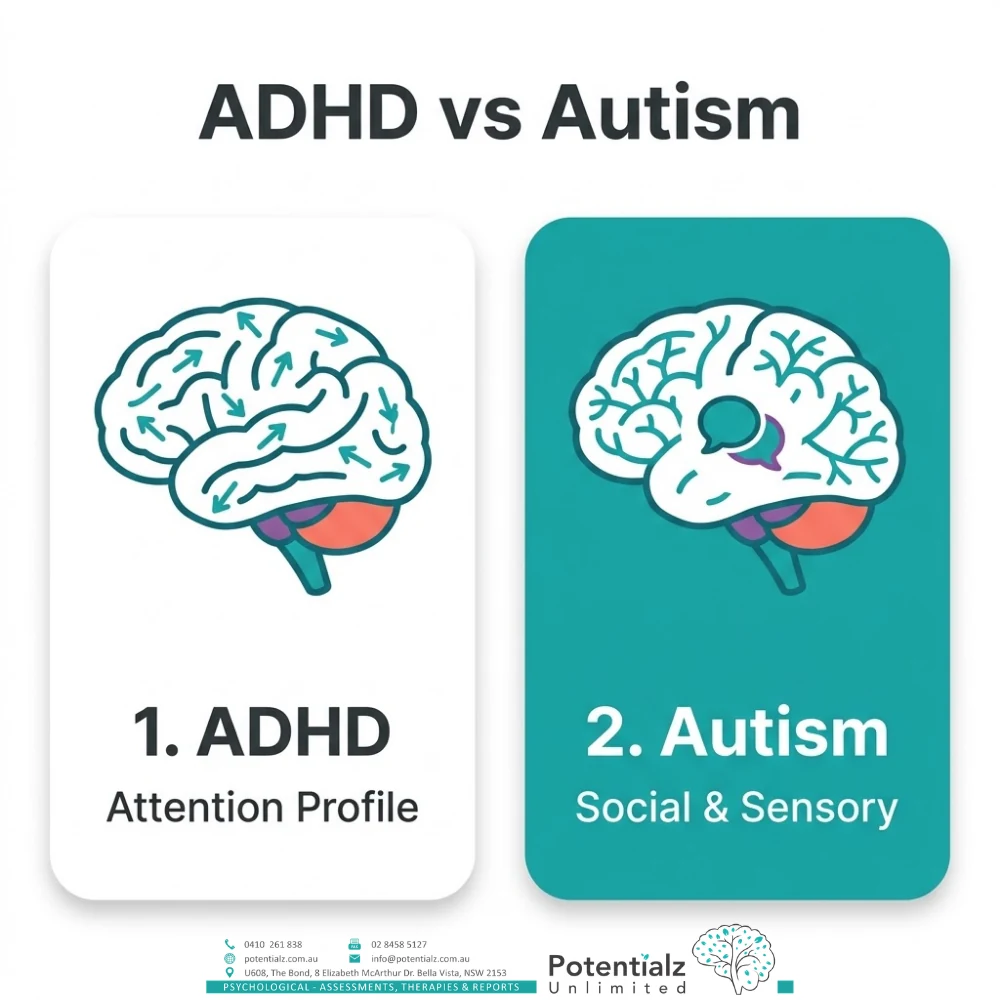
At the simplest level:
- ADHD sits primarily in the attention regulation profile — difficulty sustaining attention on tasks that are not sufficiently stimulating, difficulty inhibiting responses, difficulty with time estimation and task initiation, variable executive function.
- Autism sits primarily in the social communication and sensory processing profile — differences in how social cues are read and reciprocal communication unfolds, patterns of restricted or focused interests, strong preferences for routine, and sensory sensitivities (over- or under-registering input).
The distinction is cleaner on paper than it is in life. Many adults have both profiles. The point of an assessment is not to force a single-label answer; it is to describe your actual profile across the relevant domains, with practical implications.
What an adult assessment actually measures
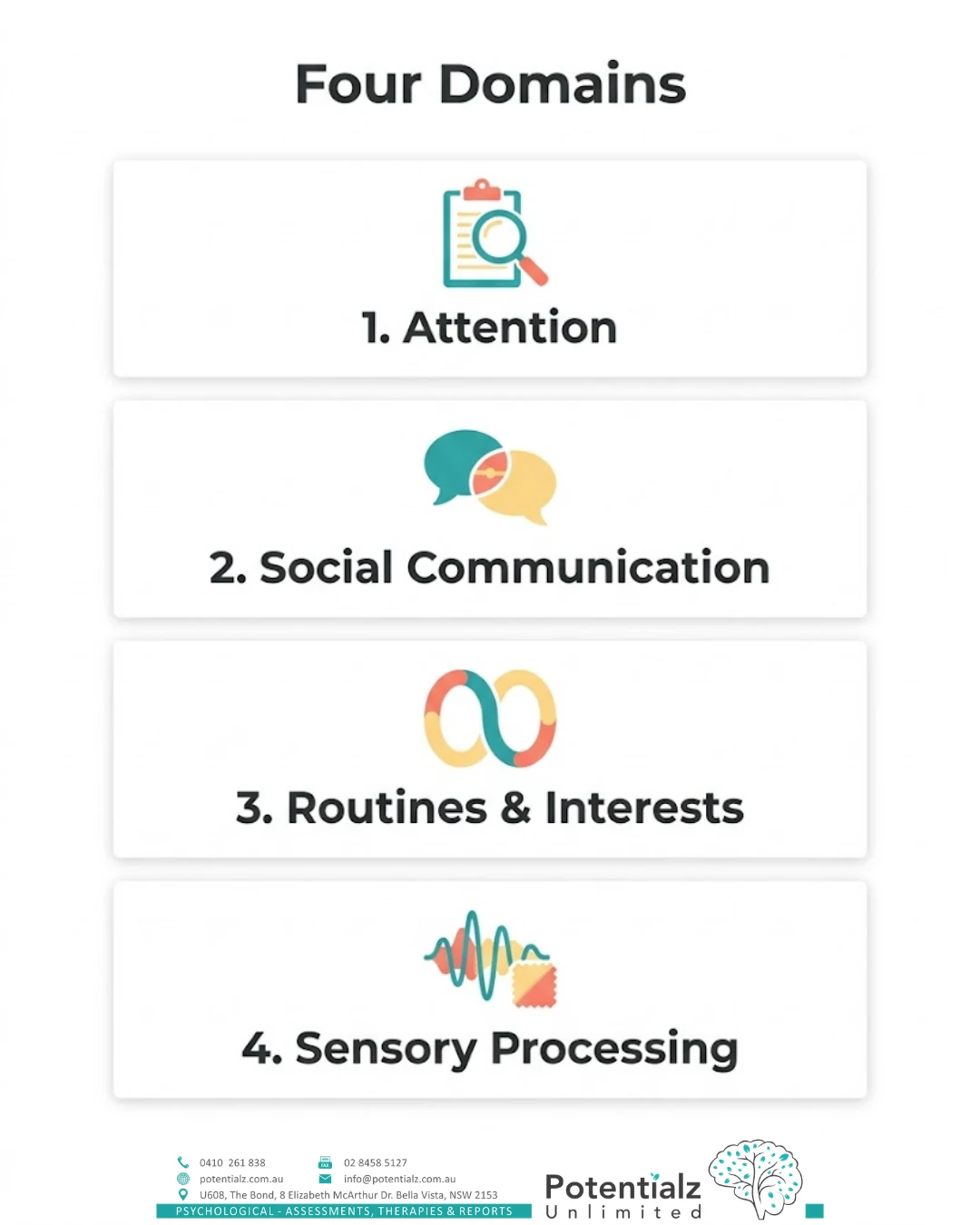
A good adult neurodevelopmental assessment covers four domains, not one or two. The weighting varies based on your presenting picture, but all four are considered.
1. Attention
Does your attention regulation match the picture of ADHD? Standardised measures of attention and executive function, careful developmental history (ADHD begins in childhood, even when it is only identified in adulthood), and current functional review across work, home and relationships.
2. Social communication
How do you experience and navigate social communication? This is not a judgement about whether you are “sociable” — many autistic adults are warm, verbally fluent and have close relationships. It is about reciprocity, reading implicit cues, and whether social interaction is cognitively effortful in ways that match an autistic profile.
3. Routines and interests
Do you have patterns of restricted or intensely focused interests? Preferences for sameness that are stronger than typical? These are features of the autistic profile and are often sources of real strength (deep expertise, high-quality work) as well as challenge (difficulty with change).
4. Sensory processing
How does your nervous system handle sensory input — sound, light, texture, taste, interoceptive signals? Sensory differences sit most clearly on the autism side but can also be present in ADHD. Mapping your sensory profile is a practically important part of the assessment, because it directly shapes recommendations.
The assessment pathway
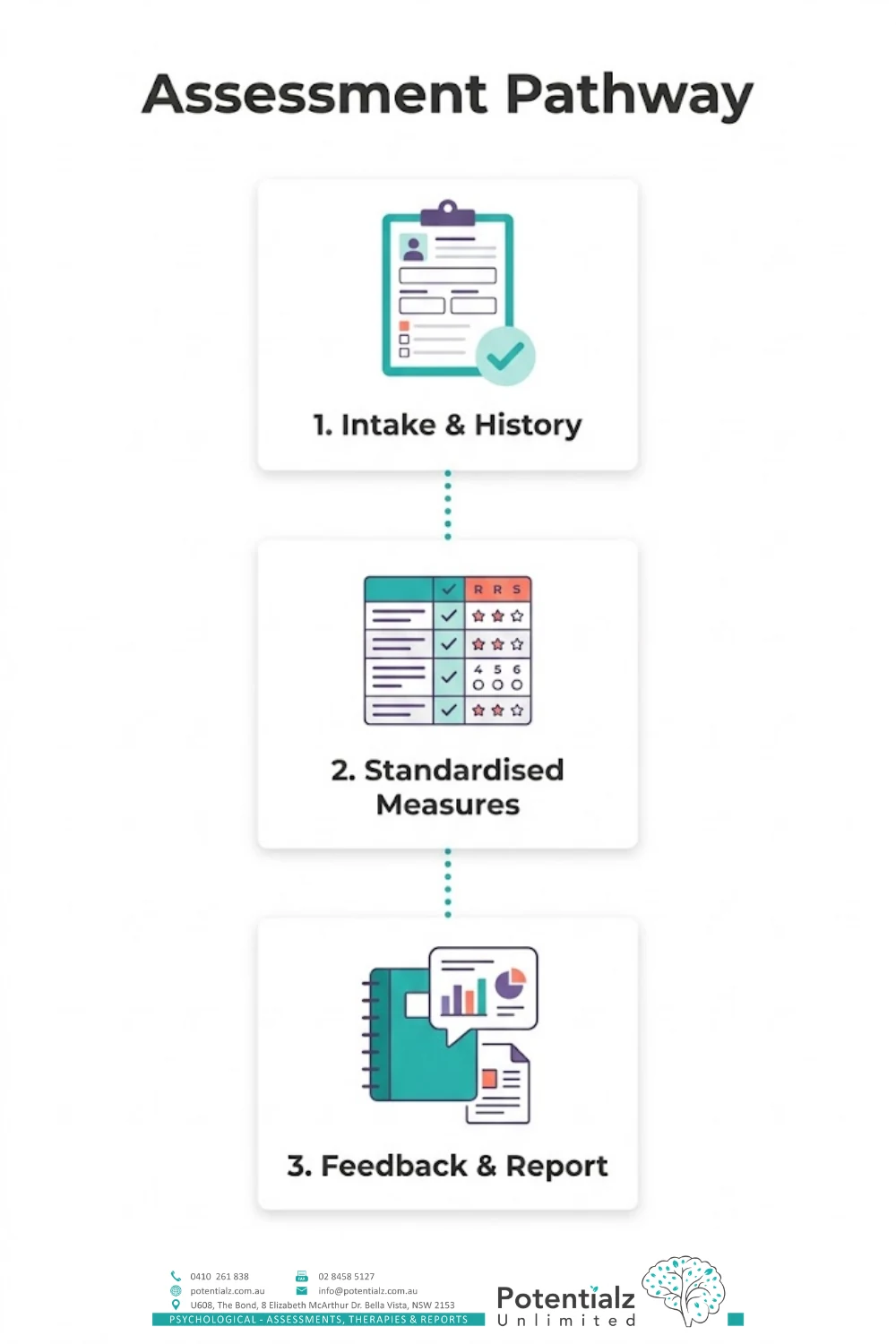
The pathway is almost always three stages, across three to five appointments:
1. Intake and history
A detailed first session that gathers your developmental history (from your own report and, where available, from a parent or long-standing partner), education and work history, mental health history, and current functional picture. This is where the shape of the assessment is tailored to you.
2. Standardised measures
Validated self-report and informant-report instruments across the four domains above, usually completed between appointments. In some adult assessments, additional in-session structured activities and observation inform the social-communication picture (this is standard in autism assessment specifically).
3. Feedback and report
A dedicated feedback session where the clinician walks you through the full picture — what the measures showed, where you sit across each of the four domains, what the diagnostic formulation is (which may be ADHD, autism, both, or neither — or another neurodevelopmental or mental-health picture that better fits), and what the practical recommendations are. A written report follows.
A good adult assessment report is not a single label. It is a profile with implications you can actually use.
Why adults seek this assessment
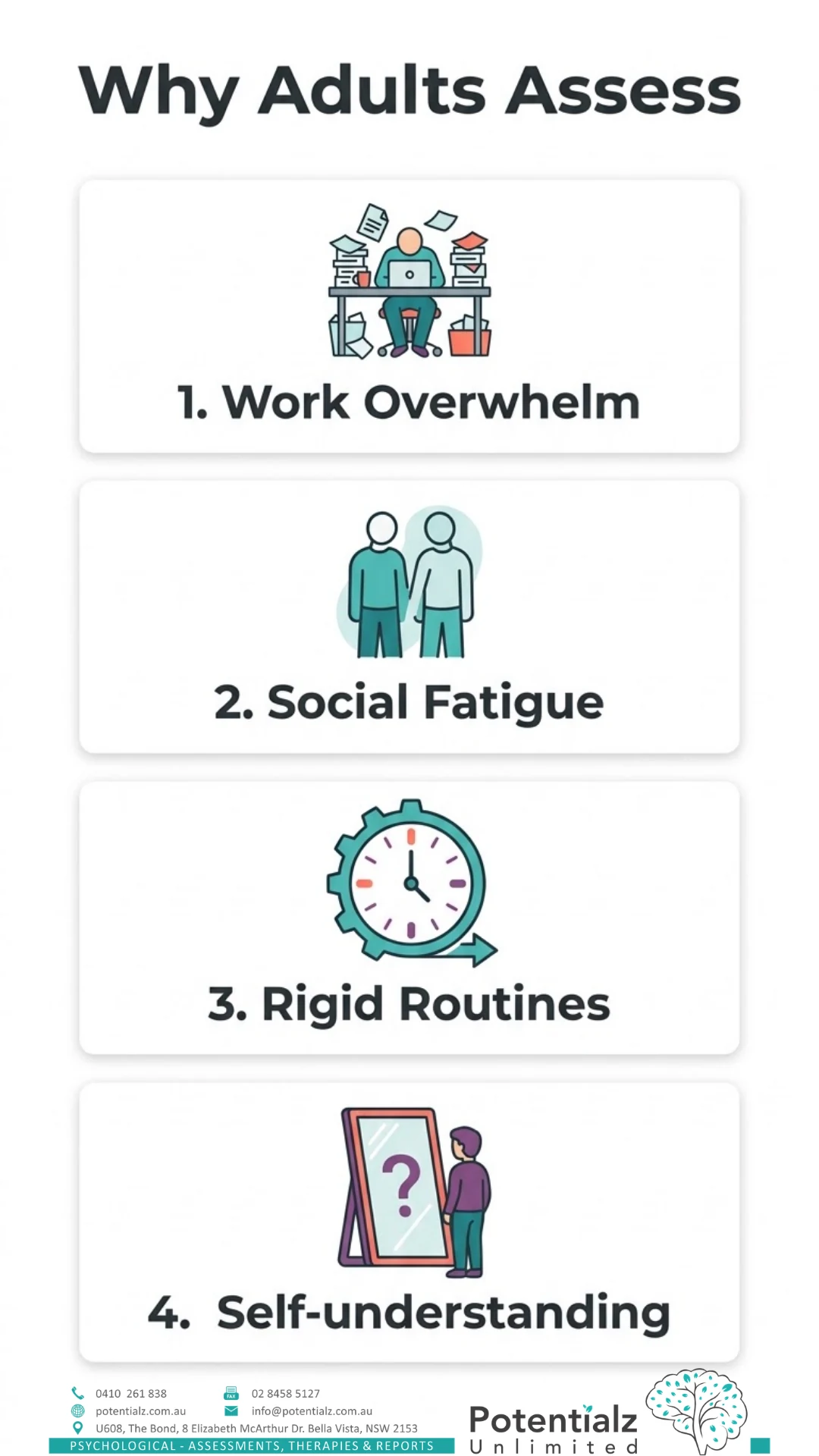
The reasons adults book assessments cluster:
- Work overwhelm. The pace, structure or interpersonal demands of work are costing more than they should, and the pattern has been long-standing.
- Social fatigue. Social interaction is more cognitively effortful than it seems to be for the people around you, and the recovery need afterwards is substantial.
- Rigid routines or strong preferences for sameness. Not pathological in themselves, but features worth understanding properly if they are shaping your life.
- Self-understanding. Something has clicked in reading about ADHD, autism, or both — and you want a clinically grounded answer to the question of whether what you are reading describes you.
Any of these is a legitimate reason. You do not need to meet a particular threshold of distress to seek assessment; many adults assess as part of a self-understanding project, not a crisis.
Overlap and distinct features
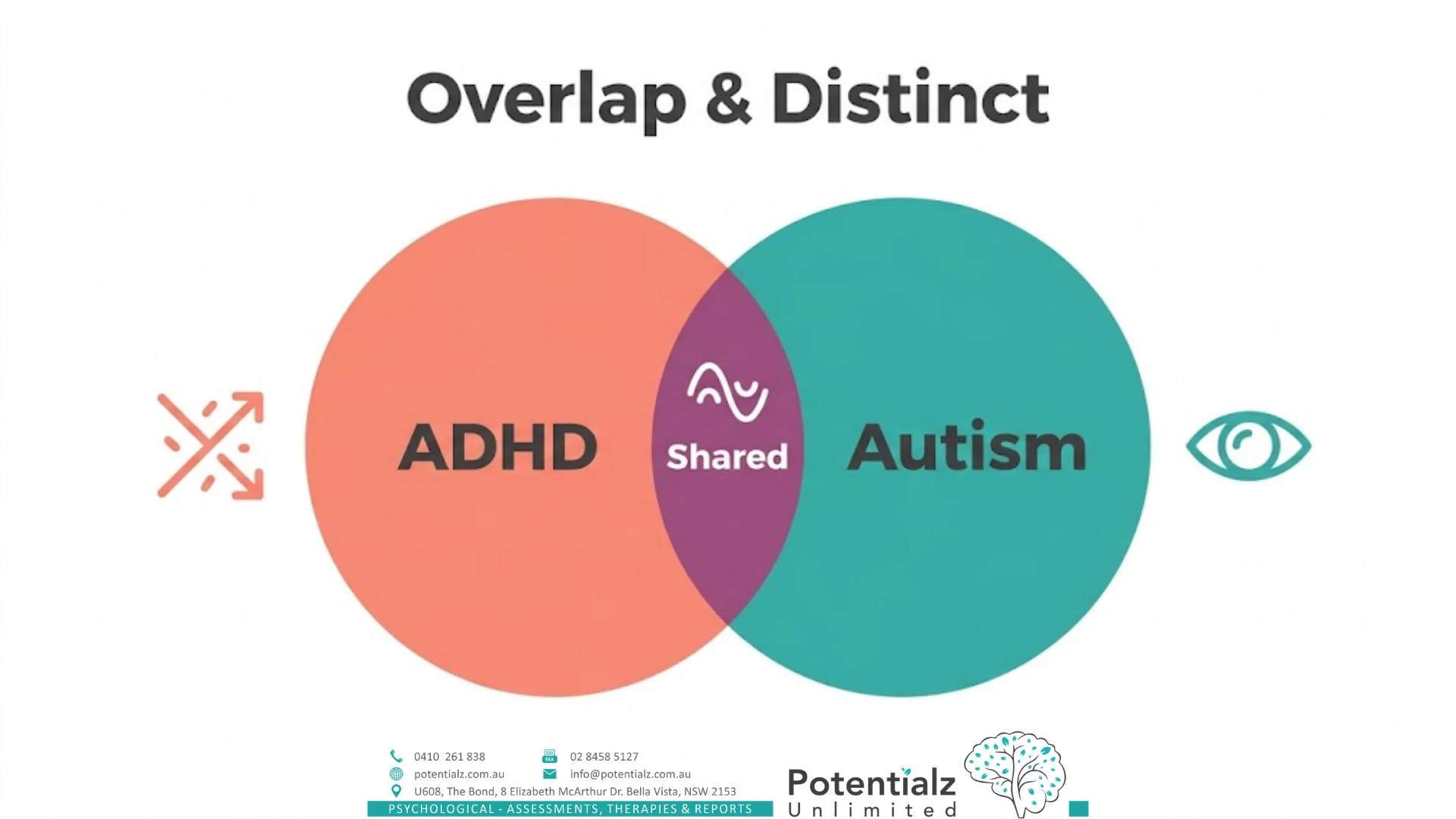
In adults, ADHD and autism share real features — enough that distinguishing them (and recognising when both are present) is a core part of a good assessment:
- Shared. Sensory processing differences, executive function challenges, emotional regulation difficulties, masking and compensatory strategies accumulated across a lifetime, higher rates of co-occurring anxiety and mood presentations.
- More distinctly ADHD. Attention variability, impulsivity, difficulty with task initiation and time estimation, response to interest-driven environments.
- More distinctly autistic. Social communication differences, restricted or focused interests, strong preferences for routine and predictability, more pervasive and stable sensory profiles.
Many adults are formally identified with both — AuDHD, in the lived-experience vocabulary — which is a legitimate, increasingly recognised profile and is not a sign that assessment was unclear. Both conditions can co-exist, and treatment and support are different when both are present.
After the assessment — using the picture
The point of the assessment is what you do with it:
- Workplace adjustments. Many adults use the assessment report to request reasonable adjustments at work — flexible scheduling, environmental adjustments, written briefs, longer deadlines where appropriate.
- Therapy fit. Knowing your profile shapes which therapy approaches work for you. Our post on how psychotherapy can help adults with ADHD is a useful starting point for the therapy angle specifically.
- NDIS eligibility (where appropriate). For autistic adults who meet NDIS access criteria, assessment reports support planning. Our differential-diagnosis NDIS guide is the deeper read on this side.
- Medication conversation (ADHD specifically). If ADHD is identified and you want to explore medication, your assessment report supports a conversation with a psychiatrist. A psychologist does not prescribe; the referral is to a psychiatrist for that part of care.
- Self-understanding and self-compassion. For many adults, the single most valuable outcome is a clinically grounded answer to a question they have carried for years. The frame shifts how they understand their life, often in a direction that supports self-compassion.
Three next steps
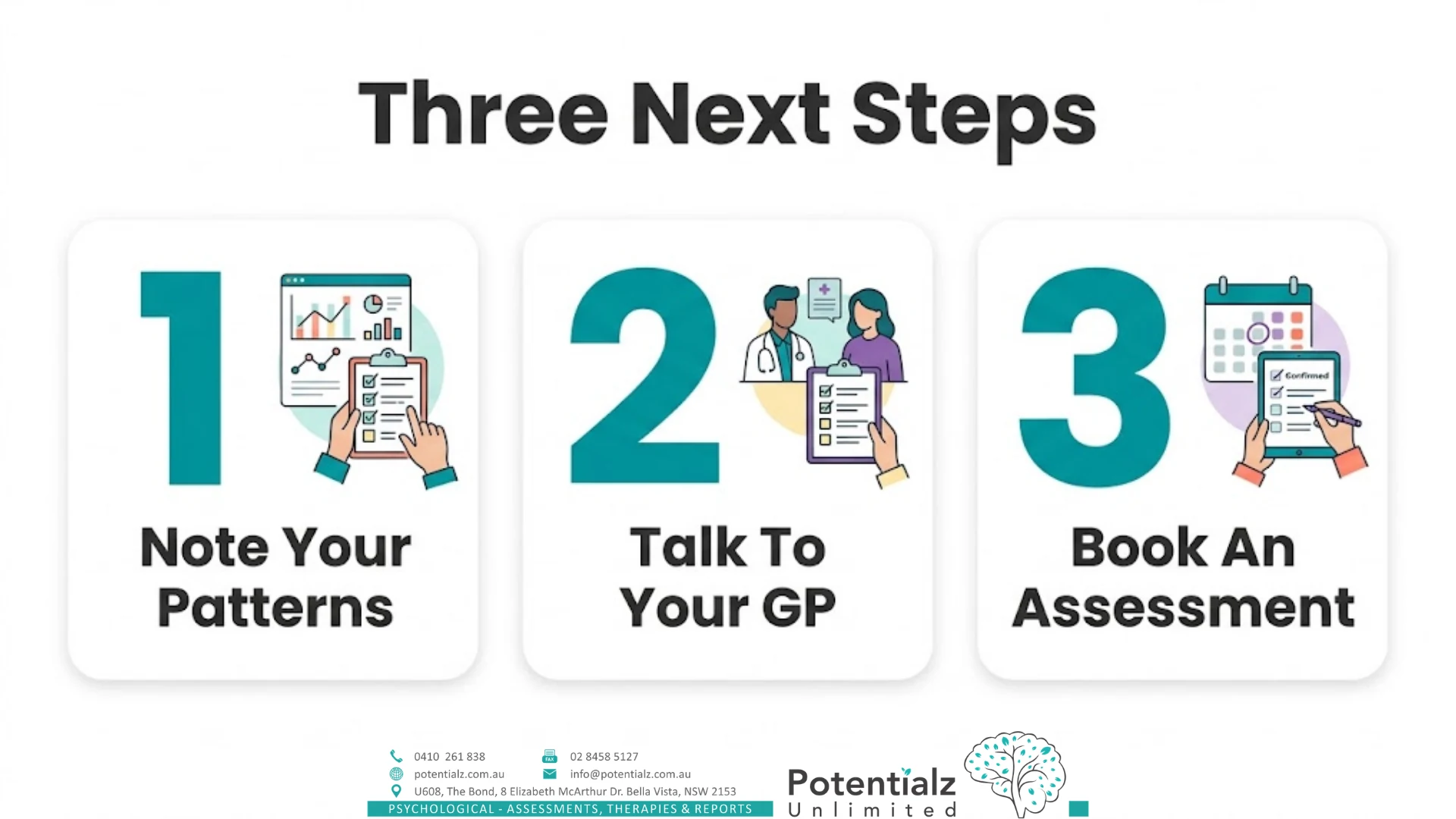
- Note your patterns. Over a few weeks, write down what you notice — the moments at work, in social settings, around sensory input, around routines. This is useful intake material.
- Talk to your GP. A GP can rule out medical contributors to similar presentations (sleep, thyroid, nutritional) and provide a referral to assessment where appropriate.
- Book an assessment. With a referral in hand, book an initial intake. The intake session itself is often clarifying before any formal measures are completed.
Frequently asked questions
Can an adult have both ADHD and autism?
Yes. Both conditions can and often do co-occur. In adults who come for assessment with a picture that doesn’t fit cleanly into one, both diagnoses may be formally identified. This is a legitimate profile and shapes recommendations accordingly.
Why would I get assessed if I have been managing fine so far?
Many adults ask this. Common answers from clients: the “managing fine” has cost more than it looked like it did; patterns are becoming more expensive with age (less capacity for compensation); understanding the underlying picture changes what work, relationships and self-care choices make sense next.
How long does a full adult assessment take?
Typically three to five appointments across four to eight weeks, including intake, measures, and feedback. The feedback session is separate from intake because the clinician needs time to score, interpret and write up before the conversation.
Will the assessment appear on my medical record?
Assessment outcomes are documented in the clinician’s records and in the report provided to you. Whether it goes to your GP depends on your consent. We discuss documentation and consent explicitly at intake.
Do I need a diagnosis to access support?
For some supports (medication for ADHD, NDIS for autism where criteria are met), yes. For others (therapy, self-understanding, workplace adjustments in many contexts), a profile description can be sufficient. The assessment feedback session covers which doors a formal diagnosis opens for your specific picture.
What about autism assessment under NDIS guidelines?
If NDIS is on your radar, our adult autism diagnosis in Australia post covers the national guideline specifically.
If you are an adult wondering about ADHD, autism, or both and want to work with a psychologist in the Hills District, Potentialz Unlimited offers neurodevelopmental assessments from our Bella Vista rooms. A first conversation is the right starting point — and in our experience, the clarity that follows is worth the effort.
Knowledge Check Quiz
Test what you have just read. Choose your answer for each question, then submit to reveal the answers and your score.
Need Professional Support?
If you're experiencing mental health concerns, our team is here to help.