What This Article Covers
When you’re helping your child with homework or trying to learn something new yourself, have you ever wondered why some tasks feel easier than others? The answer lies in cognitive skills—the mental abilities that shape how we learn, think, and solve everyday problems.
Living in the vibrant communities around Bella Vista, including suburbs like Norwest, Castle Hill, Kellyville, and Baulkham Hills, families often juggle busy schedules, schoolwork, and cultural diversity. Understanding cognitive skills can help make learning smoother and problem-solving less stressful for everyone.
This guide explains what cognitive skills are, how they affect learning and problem-solving, and practical ways to strengthen them at home.
Understanding Cognitive Skills: Your Brain’s Toolkit
Cognitive skills are the mental abilities your brain uses to process information, remember things, pay attention, and solve problems. Think of them as your brain’s toolkit—different tools for different jobs.
The Main Cognitive Skills
- Attention: The ability to focus on what’s important and ignore distractions. When your child concentrates on reading despite the TV being on, they’re using attention skills.
- Memory: How we store and recall information. This includes remembering your shopping list, recalling facts for a test, or remembering where you put your keys.
- Processing Speed: How quickly your brain understands and responds to information. This affects how fast you can read, answer questions, or react to situations.
- Language Skills: Understanding and using words, following conversations, and expressing thoughts clearly.
- Executive Function: The “boss” skills that help you plan, organize, make decisions, and control impulses. These help you start homework on time or stick to a morning routine.
- Visual-Spatial Skills: Understanding shapes, distances, and how things relate in space. These matter when solving puzzles, reading maps, or parking a car.
For families in the Hills District, these skills matter daily—from helping children navigate multicultural environments to managing work and family responsibilities.
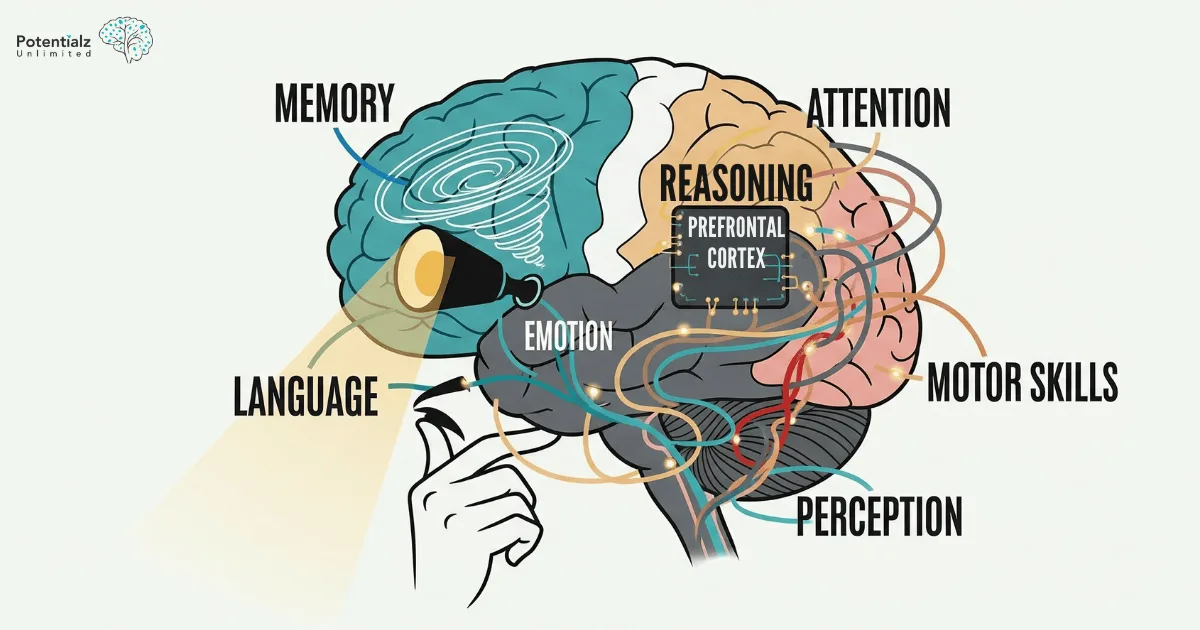 Illustration of the human brain highlighting sections responsible for cognitive skills such as memory, attention, reasoning, emotion, language, motor skills, and perception.
How Cognitive Skills Shape the Learning Process
Learning isn’t just about memorizing facts. It’s a complex process where different cognitive skills work together like musicians in an orchestra. When one skill struggles, the whole learning experience can feel harder.
The Learning Cycle
Step 1: Paying Attention Before you can learn anything, you need to focus. Attention skills help filter out distractions and concentrate on what matters. A child struggling with attention might miss important instructions, not because they don’t care, but because their attention skills need support.
Step 2: Processing Information Once you’re paying attention, your brain needs to make sense of what it’s receiving. Processing speed and language skills help you understand new information quickly and accurately.
Step 3: Storing Memories After understanding something, you need to remember it. Memory skills move information from short-term memory (like holding a phone number long enough to dial it) to long-term memory (knowing it weeks later).
Step 4: Applying Knowledge The final step is using what you’ve learned. Executive function and reasoning skills help you apply knowledge to new situations—like using maths learned in class to calculate change at the shops.
Real-Life Example: Learning to Read
When a Year 3 student in Castle Hill learns to read, they’re using multiple cognitive skills simultaneously:
- Attention to focus on the words
- Visual-spatial skills to recognize letter shapes
- Language skills to connect sounds with letters
- Memory to remember what words mean
- Processing speed to read smoothly without getting stuck on each word
If one of these skills is weaker, reading becomes harder. This is why some bright children struggle with reading—it’s not about intelligence, but about specific cognitive skills needing support.
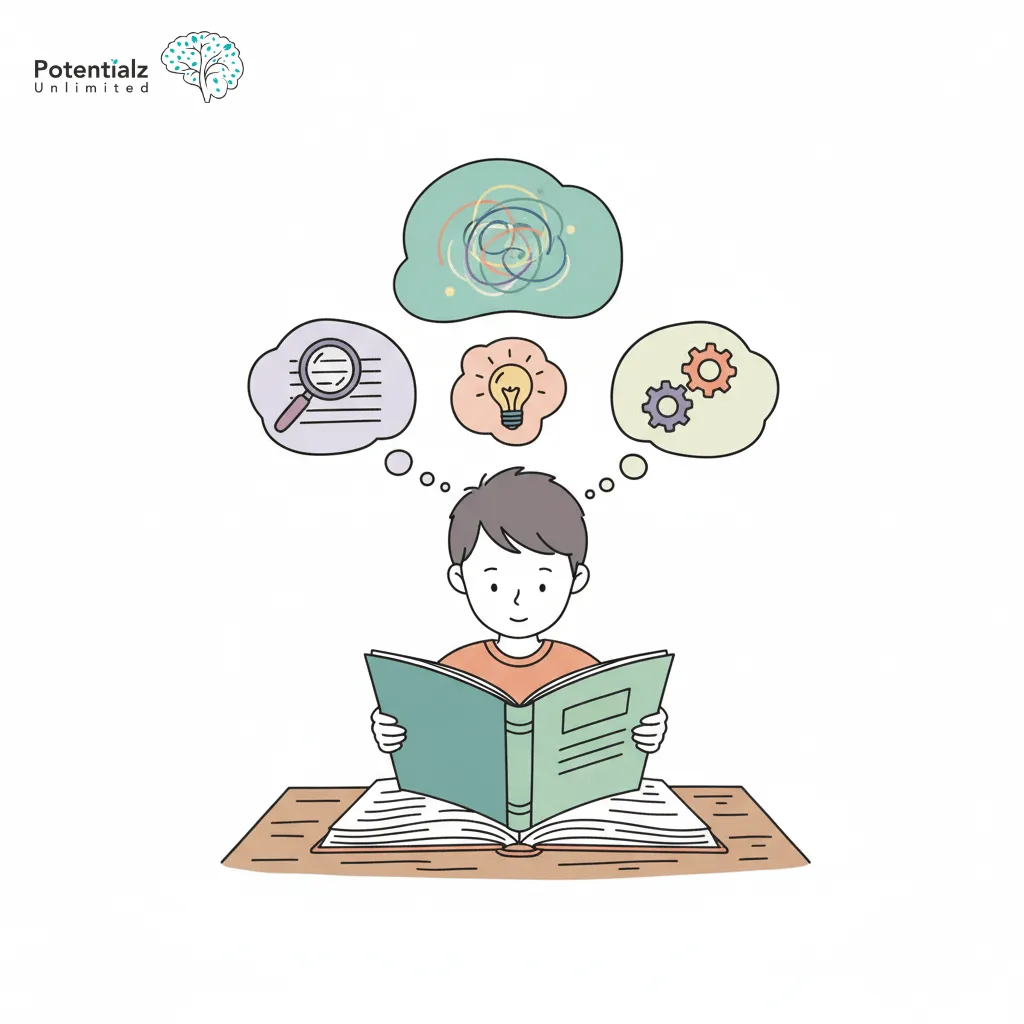 A child engrossed in a book explores a world of ideas, imagination, and understanding, with thought bubbles representing curiosity, creativity, and problem-solving.
According to research published in the Journal of Educational Psychology, cognitive skills account for significant differences in learning outcomes, even when children have similar educational opportunities (Deary et al., 2007). This highlights why understanding these skills matters for every family.
The Connection Between Cognitive Skills and Problem-Solving
Problem-solving happens constantly in daily life. Whether you’re figuring out the quickest route to Parramatta during traffic, helping your teenager resolve a friendship conflict, or deciding how to manage family finances, you’re using cognitive skills.
The Problem-Solving Process
Identifying the Problem Before solving anything, you need to recognize there’s a problem. This requires attention skills to notice something’s wrong and language skills to define the issue clearly.
Example: Your child says, “I can’t do my homework.” The real problem might be they don’t understand the instructions, can’t remember what to do, or feel overwhelmed by the amount of work.
Analyzing the Situation Next, you gather information and understand what’s happening. This uses memory (recalling similar situations), reasoning (thinking logically about causes), and attention (focusing on relevant details).
Generating Solutions Creative thinking and flexibility help you come up with different options. Executive function skills help you think of multiple approaches rather than getting stuck on one idea.
Example: If homework feels overwhelming, solutions might include breaking it into smaller chunks, taking breaks, asking for help, or starting with easier tasks first.
Evaluating Options Reasoning and judgment skills help you weigh the pros and cons of each solution. Working memory holds different options in mind while you compare them.
Implementing the Solution Executive function skills help you plan and carry out your chosen solution. Processing speed affects how quickly you can act.
Reflecting on Results After trying a solution, you evaluate whether it worked. This feedback loop strengthens problem-solving skills over time, building what researchers call “cognitive flexibility” (Diamond, 2013).
Why Some Problems Feel Harder
When cognitive skills are stretched, problem-solving becomes exhausting. For families managing busy lives in Bella Vista and surrounding suburbs, stress can temporarily reduce cognitive capacity, making even simple problems feel overwhelming.
Understanding this can bring relief—struggling doesn’t mean you’re failing; it might mean your cognitive resources are stretched thin and need support.
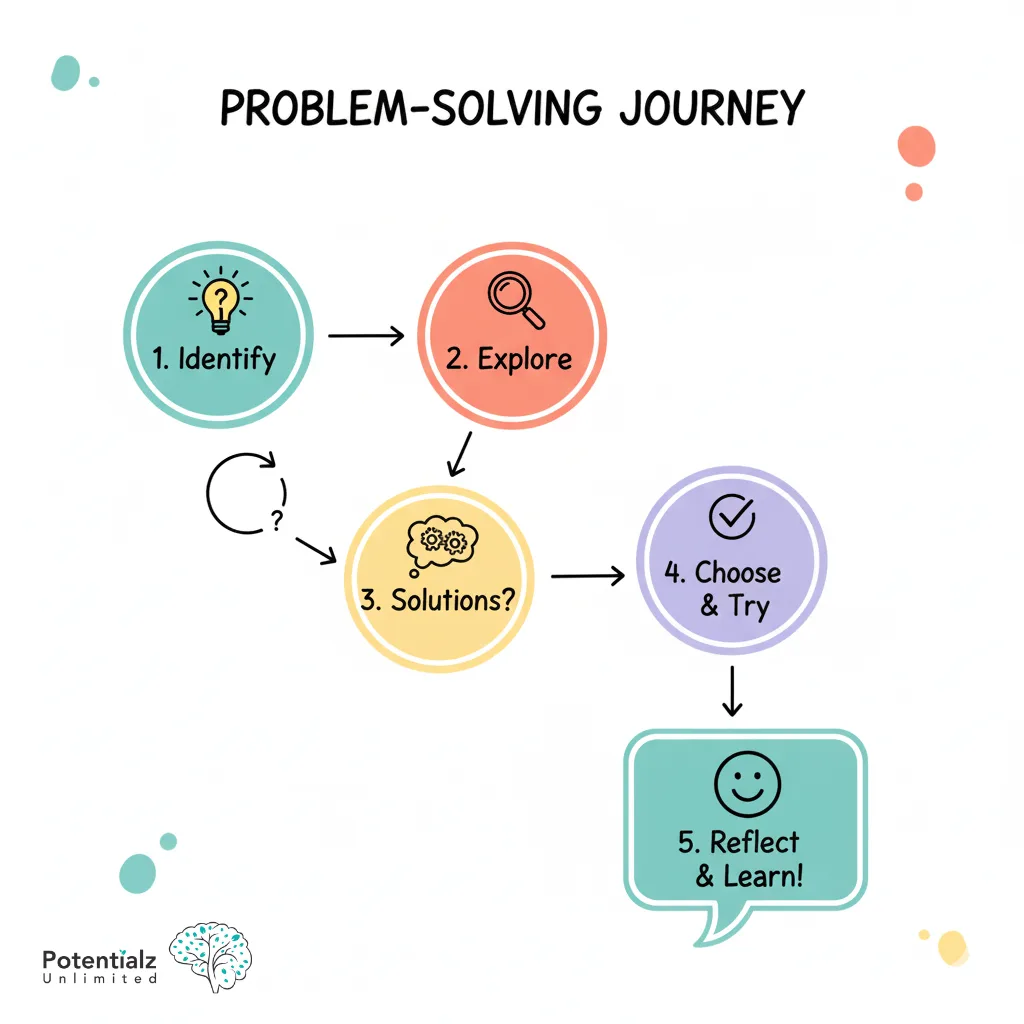 A friendly flowchart illustrating the problem-solving journey: 1. Identify, 2. Explore, 3. Solutions?, 4. Choose & Try, 5. Reflect & Learn!
What Are the 5 Key Cognitive Assessments?
Understanding cognitive skills is helpful, but sometimes families need a clearer picture of specific strengths and challenges. This is where cognitive assessments come in. These aren’t about passing or failing—they’re tools to understand how someone’s brain works best.
Common Cognitive Tests
1. Intelligence Testing (IQ Tests) These assess overall cognitive ability across multiple areas including reasoning, memory, and processing speed. The most common is the Wechsler Intelligence Scale for Children (WISC-V) or adults (WAIS-IV).
When it helps: If there’s a big gap between effort and achievement, or when considering educational support options.
2. Memory Assessments These evaluate different types of memory—short-term, working memory, and long-term memory. Tests might involve remembering word lists, numbers, or visual patterns.
When it helps: If someone frequently forgets instructions, struggles to follow multi-step directions, or can’t recall recently learned information.
3. Attention and Concentration Tests These measure sustained attention, selective attention (focusing amid distractions), and attention span. Common tests include the Test of Variables of Attention (TOVA) or Conners Continuous Performance Test.
When it helps: When distractibility, impulsivity, or difficulty completing tasks is a concern—particularly for ADHD assessment.
4. Processing Speed Assessments These evaluate how quickly someone can understand and respond to information. Tasks might involve quickly matching symbols, finding patterns, or making simple decisions under time pressure.
When it helps: If someone needs extra time for tasks, works very slowly despite understanding, or struggles with timed tests.
5. Executive Function Tests These assess planning, organization, impulse control, and flexible thinking. Tests might involve problem-solving tasks, planning activities, or switching between different rules.
When it helps: When difficulties with organization, starting tasks, managing time, or controlling impulses affect daily life.
What Happens During a Cognitive Assessment?
At our clinical psychology practice in Bella Vista, a cognitive assessment typically involves:
- Initial consultation: Understanding concerns and background
- Testing session: Usually 2-4 hours, with breaks for children
- Scoring and interpretation: The psychologist analyzes results
- Feedback session: Discussing findings and recommendations
- Written report: Detailed results and practical strategies
The process is designed to be comfortable and supportive, not stressful. For children, tests often feel like puzzles or games rather than exams.
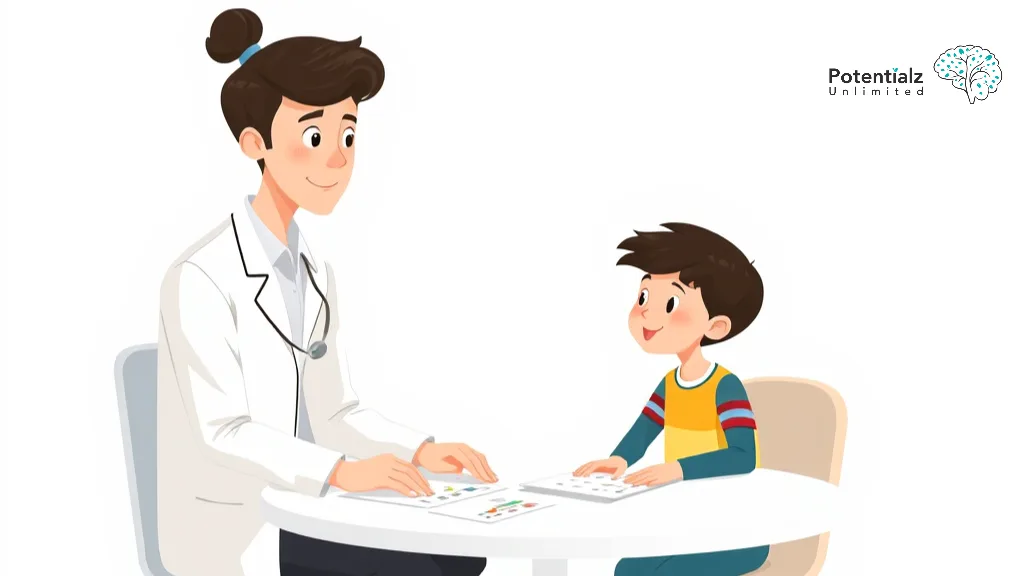 A psychologist and child engaging in a relaxed testing session, fostering a supportive and interactive environment.
Research in Psychological Assessment shows that comprehensive cognitive evaluations provide valuable information for tailoring educational interventions and support strategies (Strauss et al., 2006). This means assessment results translate into real, practical help.
How Different Age Groups Use Cognitive Skills
Cognitive skills develop throughout life, and understanding what’s typical at different ages helps set realistic expectations and identify when extra support might help.
Early Childhood (Ages 3-7)
Learning Focus: Basic language, early reading and maths, following instructions, playing with others.
Key Cognitive Developments:
- Attention span gradually increases from a few minutes to 15-30 minutes
- Memory improves for daily routines and familiar stories
- Problem-solving becomes more logical and less trial-and-error
- Language skills expand rapidly
Common Challenges: Short attention span, difficulty waiting turns, emotional regulation during frustration.
Support Strategies: Short, engaging activities; lots of praise; breaking tasks into tiny steps; using play to teach concepts.
Middle Childhood (Ages 8-12)
Learning Focus: More complex reading and writing, abstract maths concepts, organizing schoolwork, developing friendships.
Key Cognitive Developments:
- Working memory strengthens, allowing mental maths and multi-step problems
- Attention becomes more selective and sustained
- Logical reasoning develops
- Self-awareness of learning strengths and weaknesses grows
Common Challenges: Increased homework demands, comparison with peers, executive function requirements for managing multiple subjects.
Support Strategies: Teaching organizational systems, encouraging strengths while supporting challenges, maintaining homework routines.
Adolescence (Ages 13-18)
Learning Focus: Advanced academic concepts, planning for the future, independence, complex social relationships.
Key Cognitive Developments:
- Abstract thinking fully develops
- Executive function matures (but continues developing into the 20s)
- Processing speed peaks
- Metacognition—thinking about thinking—improves
Common Challenges: Balancing multiple demands, emotional intensity affecting focus, risk-taking behavior, sleep deprivation impacting cognition.
Support Strategies: Involving teens in problem-solving, teaching time management, respecting growing independence while providing guidance, prioritizing sleep.
Adulthood
Learning Focus: Professional skills, lifelong learning, managing complex life demands.
Key Cognitive Realities:
- Most cognitive skills remain stable through middle age
- Processing speed may slow slightly, but experience compensates
- Wisdom and expertise grow
- Cognitive reserve (brain resilience) builds through continuous learning
Common Challenges: Balancing work-family demands, stress impacting focus and memory, feeling “not as sharp” as when younger.
Support Strategies: Stress management, continued learning, physical exercise (strongly linked to cognitive health), adequate sleep.
For families across the Hills District—from Bella Vista to Rouse Hill—recognizing these developmental patterns helps normalize experiences and identify when professional support like psychology services might be beneficial.
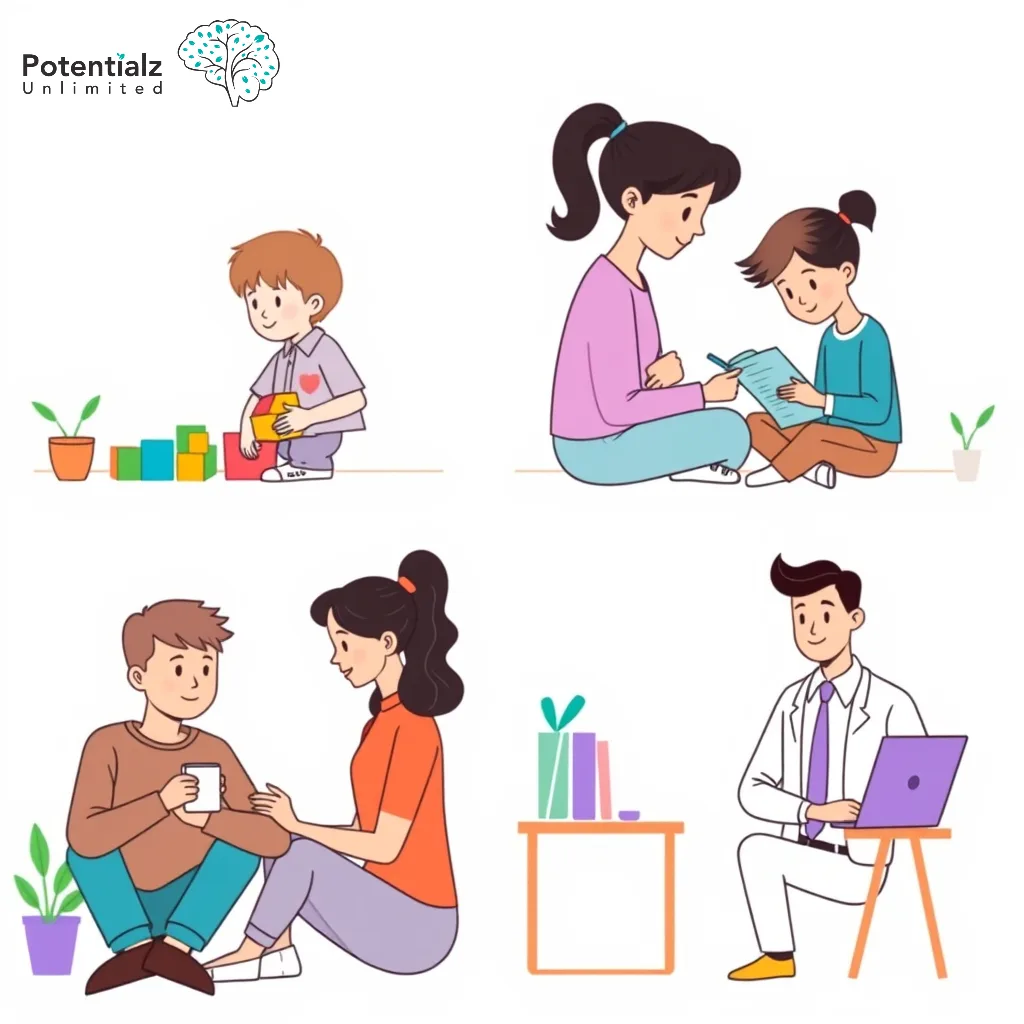 The journey of cognitive development: From playful blocks to thoughtful work, each life stage embraces learning and growth.
Practical Ways to Strengthen Cognitive Skills at Home
The good news is that cognitive skills can be strengthened through everyday activities. You don’t need expensive programs or special equipment—just consistent, engaging practice.
Activities for Better Attention
Mindful Moments Start with just 2-3 minutes of quiet attention practice. For children, this might be listening for different sounds, focusing on breathing, or observing details in a picture.
Progressive Activities Begin with short tasks and gradually increase duration. A child who can focus for 10 minutes can slowly build to 15, then 20 minutes with practice.
Reduce Distractions Create a calm homework or work space. Turn off notifications, clear visual clutter, and use noise-cancelling headphones if needed.
Movement Breaks Attention actually improves after physical activity. Short movement breaks between tasks help maintain focus better than pushing through fatigue.
Memory Boosters
Story Building When reading together, pause and ask what happened earlier in the story. This strengthens recall and comprehension.
Memory Games Card matching games, “I went shopping and bought…”, or remembering lists all build memory skills while having fun.
Chunking Information Break information into smaller groups. Instead of remembering a 10-digit phone number, remember it as three chunks: (02) 8811-4953.
Use Multiple Senses Information learned through multiple senses (seeing, hearing, doing) sticks better. Write notes while studying, explain concepts aloud, or create visual diagrams.
Executive Function Development
Planning Together Involve children in planning family activities, packing for outings, or organizing their school week. This teaches planning skills naturally.
Problem-Solving Conversations When problems arise, ask: “What could we try?” rather than immediately solving it for them. Guide them through the problem-solving process.
Routine and Structure Consistent routines reduce the executive function load, leaving more mental energy for learning and flexible thinking when needed.
Visual Schedules Charts, calendars, and checklists reduce mental burden and teach organizational skills.
Processing Speed Support
Reduce Time Pressure Allow extra time for tasks when possible. Rushing often leads to errors and increased stress.
Practice Basic Skills Fluency comes with practice. Regular reading, maths practice, or typing builds automaticity—doing things without needing to think through each step.
Acknowledge Effort, Not Just Speed Emphasize accuracy and understanding over speed. “I can see you thought carefully about that” reinforces good cognitive habits.
Language and Reasoning Activities
Rich Conversations Talk about daily experiences, ask open-ended questions, and discuss “why” and “how” rather than just “what.”
Read Widely Exposure to diverse vocabulary and complex sentences through reading builds language skills that support all learning.
Play Strategy Games Chess, checkers, card games, and board games all develop reasoning, planning, and strategic thinking.
Everyday Maths Involve children in real-world maths: calculating change, measuring ingredients, estimating distances, or comparing prices while shopping.
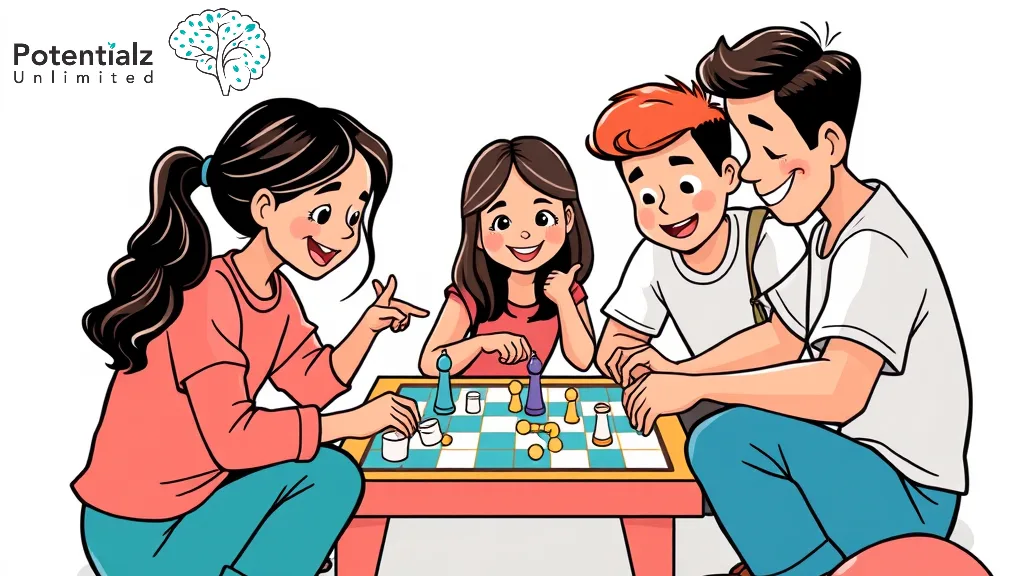 A family enjoys a lively and engaging board game session, turning learning into fun.
For families managing busy schedules in Norwest, Kellyville, and surrounding areas, these activities can fit naturally into daily routines—in the car, during dinner, or on weekends.
When Cognitive Challenges Need Professional Support
Sometimes cognitive difficulties persist despite good efforts at home. Knowing when to seek professional assessment can prevent years of unnecessary struggle and frustration.
Signs That Assessment Might Help
For Children and Adolescents:
- Persistent difficulty learning despite trying hard
- Large gap between apparent intelligence and school performance
- Extreme frustration with homework or learning tasks
- Difficulty following instructions despite good hearing
- Poor memory for recently learned information
- Unable to focus even on enjoyable activities
- Significantly slower than peers at most tasks
- Difficulty organizing belongings, thoughts, or time
- Behavioral problems that might stem from learning frustration
For Adults:
- Ongoing difficulties with concentration or memory affecting work
- Taking much longer than others to complete similar tasks
- Frequently losing things or forgetting important information
- Difficulty managing multiple responsibilities
- Concerns about cognitive changes after injury or illness
- Wanting to understand lifelong learning patterns better
What Professional Support Offers
Accurate Understanding Assessment identifies specific cognitive strengths and weaknesses, moving beyond guessing to targeted support.
Tailored Strategies Recommendations are personalized based on your unique profile, not generic advice.
Educational Accommodations Assessment reports can help schools provide appropriate support, such as extra time for tests, modified assignments, or specific teaching approaches.
Reduced Stress Understanding the “why” behind difficulties reduces self-blame and frustration for both children and adults.
NDIS Access For those eligible, cognitive assessment reports support NDIS psychology funding applications.
Conditions Often Involving Cognitive Challenges
Several conditions commonly affect cognitive skills:
ADHD: Primarily impacts attention, working memory, and executive function. Learn more about ADHD assessment and support.
Learning Disabilities: Affect specific cognitive skills despite average or above-average intelligence.
Anxiety and Depression: Can significantly reduce cognitive capacity, particularly attention, memory, and processing speed. Our anxiety psychologists can help.
Autism Spectrum Disorder: Often involves differences in processing, attention patterns, and executive function.
Traumatic Brain Injury: Can affect various cognitive skills depending on injury location and severity.
Neurodevelopmental Conditions: Various conditions affect cognitive development in specific ways.
At our practice in Bella Vista, our experienced clinical psychologists, led by Dr. Gurprit Ganda with over 22 years of experience, provide comprehensive cognitive assessments and evidence-based support for children, adolescents, and adults.
 A warm and inviting psychologist’s office with plush armchairs and soft lighting, offering a comfortable and professional space for clients.
Building Cognitive Resilience: The Role of Overall Wellbeing
Cognitive skills don’t exist in isolation—they’re deeply connected to physical health, emotional wellbeing, and environmental factors. Supporting cognitive development means caring for the whole person.
Sleep: The Foundation of Cognitive Function
Research published in Nature Reviews Neuroscience shows that sleep is critical for memory consolidation, attention, and executive function (Walker, 2017). During sleep, your brain processes the day’s learning and “cleans” itself of metabolic waste.
Age-Appropriate Sleep Recommendations:
- Ages 3-5: 10-13 hours
- Ages 6-12: 9-12 hours
- Ages 13-18: 8-10 hours
- Adults: 7-9 hours
Sleep Hygiene Tips:
- Consistent bedtime and wake time, even on weekends
- Screen-free hour before bed
- Cool, dark, quiet bedroom
- Avoid caffeine after lunch for children and early afternoon for adults
Nutrition for Brain Health
The brain uses about 20% of the body’s energy despite being only 2% of body weight. What we eat directly impacts cognitive function.
Brain-Friendly Nutrition:
- Omega-3 fatty acids (fish, walnuts, flaxseed) support brain structure and function
- Complex carbohydrates (whole grains, vegetables) provide steady energy
- Protein (lean meat, eggs, legumes) builds neurotransmitters
- Antioxidants (berries, colorful vegetables) protect brain cells
- Adequate hydration—even mild dehydration impairs cognition
For children, regular meals and snacks prevent blood sugar dips that affect concentration. For busy families in Castle Hill and Baulkham Hills, meal planning helps ensure consistent nutrition despite hectic schedules.
Physical Activity and the Brain
Exercise isn’t just for physical health—it’s one of the most powerful cognitive enhancers. Physical activity increases blood flow to the brain, promotes new brain cell growth, and releases chemicals that improve mood and learning.
How Much Activity?
- Children and adolescents: 60 minutes of moderate-to-vigorous activity daily
- Adults: 150 minutes of moderate activity weekly
Activities Don’t Need to Be Formal:
- Walking or cycling to school
- Playing at local parks in Bella Vista or Norwest
- Family sports or active games
- Dancing
- Swimming
The British Journal of Sports Medicine published research showing that even short bursts of activity throughout the day improve attention and memory (Pontifex et al., 2013).
Stress Management
Chronic stress floods the brain with cortisol, which impairs memory, reduces attention, and shrinks the hippocampus (the brain’s memory center). Managing stress protects cognitive function.
Family Stress Reduction:
- Regular family time without screens
- Teaching simple breathing exercises
- Maintaining realistic expectations
- Balancing activities with downtime
- Seeking support when needed
For families experiencing significant stress, our psychology services include stress management strategies and support. Sometimes professional help like CBT therapy provides tools for managing overwhelming situations.
Social Connection and Cognitive Health
Strong relationships and social engagement support cognitive health across the lifespan. Conversations, cooperative play, and shared activities all exercise cognitive skills while building emotional wellbeing.
For families in the Hills District’s multicultural communities, maintaining cultural connections while building new relationships enriches cognitive development through exposure to diverse perspectives and languages.
 Children joyfully run hand in hand through the park, embodying the spirit of playful friendship and carefree fun in the great outdoors.
Technology: Friend or Foe for Cognitive Development?
Living in 2025, technology is unavoidable, and parents often worry about its impact on cognitive development. The reality is nuanced—technology can support or hinder cognitive skills depending on how it’s used.
The Concerns (Backed by Research)
Attention Fragmentation Constant notifications and app-switching train brains for distraction rather than sustained focus. Research in JAMA Pediatrics shows excessive screen time correlates with attention difficulties (Tamana et al., 2019).
Reduced Executive Function Practice When devices entertain constantly, children have fewer opportunities to practice managing boredom, planning activities, or problem-solving independently.
Delayed Language Development Screen time replaces conversation time. Young children learn language best through back-and-forth interactions with people, not passive watching.
Sleep Disruption Blue light and engaging content before bed disrupt sleep quality, which impacts next-day cognitive function.
The Benefits (When Used Well)
Educational Apps High-quality educational programs can teach concepts, provide practice, and adapt to a child’s learning level.
Connection Video calls with grandparents, online learning communities, and accessibility tools can support development.
Assistive Technology For children with learning difficulties, technology can provide scaffolding—text-to-speech, organizational apps, or visual schedules.
Healthy Technology Guidelines
Age-Appropriate Limits:
- Under 18 months: Avoid screens except video calls
- 18 months-2 years: High-quality programming, watched together
- 2-5 years: Maximum 1 hour daily of quality content
- 6+ years: Consistent limits balancing screen time with other activities
- Adolescents: Teach self-regulation and time management
Quality Matters More Than Quantity:
- Choose educational, interactive content over passive viewing
- Watch together and discuss what’s happening
- Use technology as a tool for creation, not just consumption
Tech-Free Zones:
- Bedrooms (for better sleep)
- Mealtimes (for family connection)
- First hour after school (for transition time)
Model Healthy Use: Parents’ technology habits powerfully influence children. If adults are constantly on devices, children learn that’s normal behavior.
For families seeking guidance on balancing technology and development, our child psychologists in Bella Vista can provide personalized strategies.
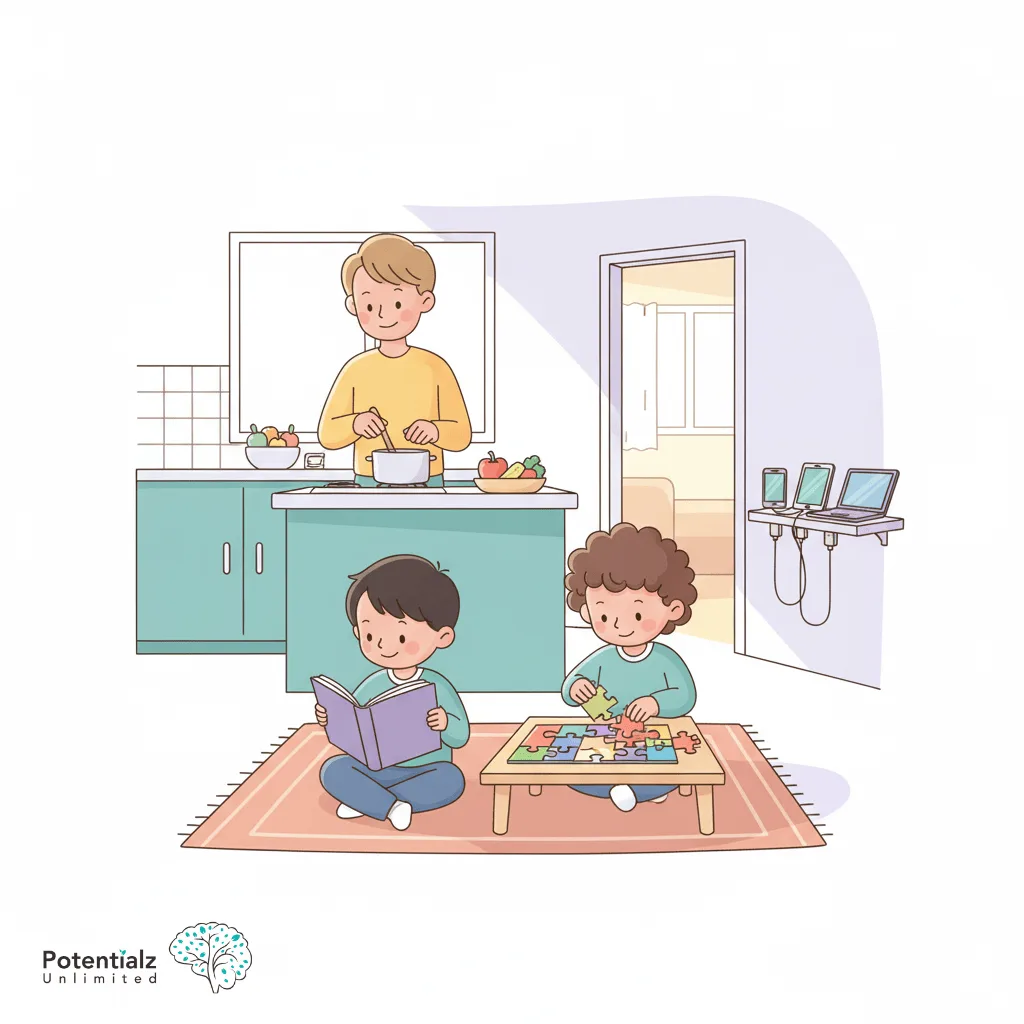 A harmonious family scene unfolds with a child engrossed in a book, another focused on a puzzle, and a parent preparing dinner, while electronic devices quietly recharge in the next room.
The Multicultural Advantage: Bilingualism and Cognitive Development
Many families in Bella Vista and surrounding suburbs speak multiple languages at home. There’s sometimes concern that bilingualism might confuse children or slow development. Research shows the opposite—bilingualism provides significant cognitive advantages.
Cognitive Benefits of Bilingualism
Enhanced Executive Function Bilingual individuals constantly practice inhibiting one language while using another. This strengthens executive function skills like:
- Cognitive flexibility (switching between mental tasks)
- Working memory
- Inhibitory control (resisting distractions)
- Problem-solving
Research in Psychological Science found that bilingual children outperform monolingual peers on executive function tasks (Bialystok, 2009).
Improved Attention Managing two language systems enhances selective attention—focusing on relevant information while filtering out distractions.
Better Cognitive Reserve Studies show bilingualism may delay dementia onset by several years by building cognitive reserve—the brain’s resilience against age-related decline.
Supporting Bilingual Development
Maintain Home Language Children benefit from strong foundation in their home language. This doesn’t hinder English learning—strong first language skills actually support second language acquisition.
Consistent Language Use Each parent speaking their language consistently (rather than mixing) helps children develop both languages fully.
Reading in Both Languages Books in home language maintain literacy skills and cultural connection while children learn English at school.
Patience with Mixing Code-switching (mixing languages) is normal and shows sophisticated linguistic awareness, not confusion.
For families concerned about language development, our team understands the unique considerations for multicultural families in the Hills District. Assessment and support can be tailored to bilingual contexts.
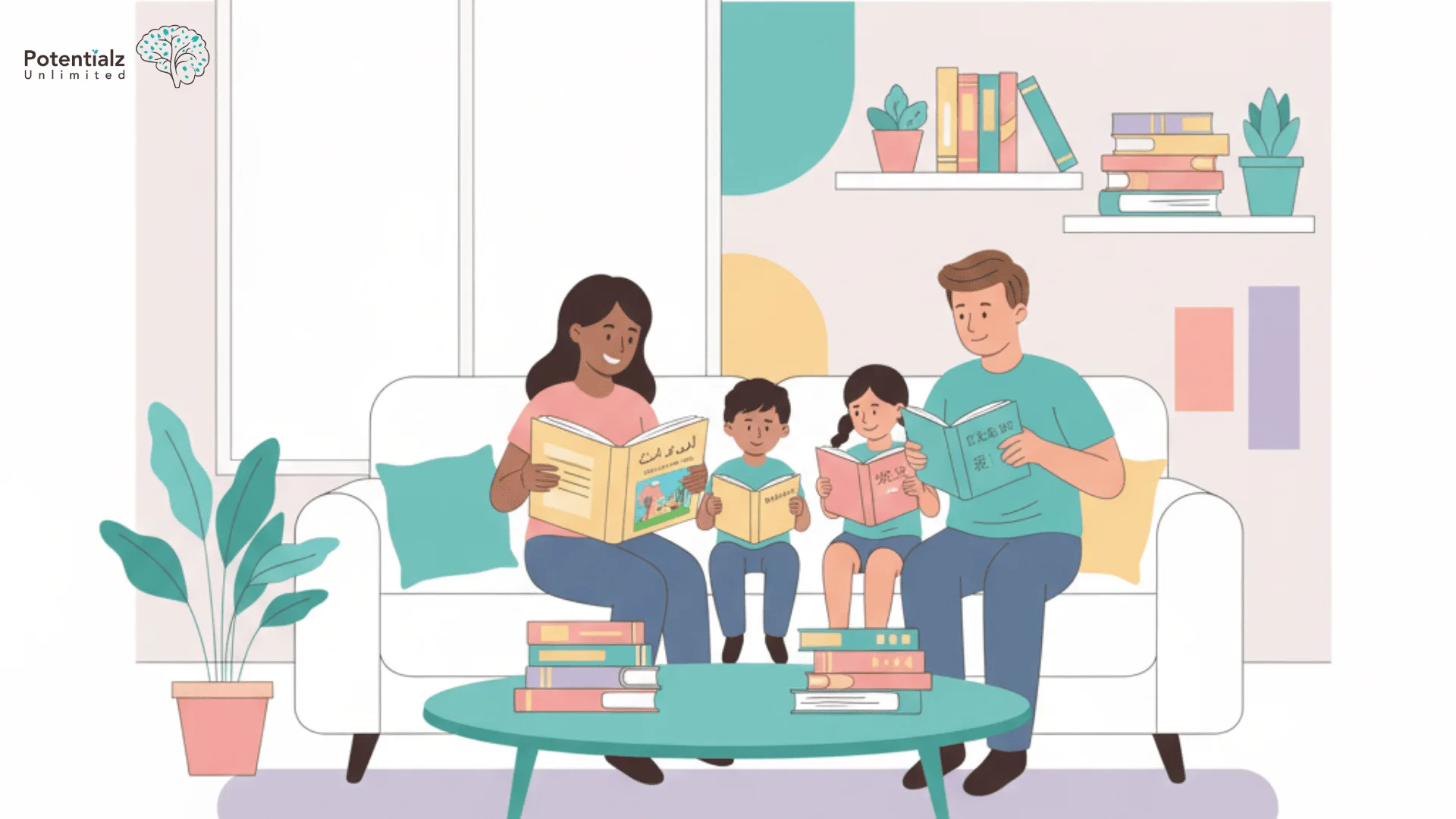 A family enjoys a cozy reading session with books in various languages, highlighting the beauty of multilingual learning at home.
Creating a Cognitive-Friendly Home Environment
The physical and emotional environment at home significantly impacts cognitive development. Small changes can make learning and problem-solving easier for everyone.
Physical Environment
Organized Spaces Visual clutter increases cognitive load. Organized spaces help attention and reduce stress:
- Designated homework/work areas
- Storage systems that make sense to the child
- Clear surfaces for focused work
- Good lighting
Minimal Distractions During focus time, reduce competing stimuli:
- Quiet space or noise-cancelling headphones
- Single tasking rather than background TV
- Phone notifications off
Brain-Break Zones Create spaces for movement and rest:
- Indoor space for physical activity (especially for apartments)
- Cozy reading corner
- Outdoor access when possible
Emotional Environment
Safe to Struggle Create a culture where mistakes are learning opportunities, not failures. This encourages the cognitive risk-taking needed for growth.
Process Over Product Praise effort, strategies, and persistence rather than just outcomes: “I noticed you tried three different approaches” rather than just “Good job.”
Realistic Expectations Understanding normal cognitive development prevents frustration. Not every 7-year-old can sit still for hour-long homework sessions—that’s developmental, not defiant.
Emotional Validation Acknowledge when tasks are genuinely hard: “This is challenging work” validates their experience and reduces shame around struggling.
Time Management
Predictable Routines Routines reduce the executive function needed for daily life, preserving cognitive energy for learning.
Built-In Breaks The brain needs rest. Schedule breaks during homework, incorporate downtime in busy schedules, and protect unstructured play time.
Realistic Scheduling Over-scheduling exhausts cognitive resources. Children need unstructured time to process learning and develop independence.
For families in Kellyville and Rouse Hill managing multiple children’s schedules, our family therapy services can help develop systems that work for your unique situation.
 A serene and tidy study space bathed in natural light, featuring lush greenery and a comfortable setup for focused work.
Special Considerations: When Cognitive Differences Are Significant
Some children and adults have cognitive profiles that differ significantly from typical patterns. Understanding these differences leads to better support and self-compassion.
Learning Disabilities
Learning disabilities are neurological differences affecting specific cognitive skills despite average or above-average intelligence. Common types include:
Dyslexia: Affects reading, spelling, and sometimes writing
Dyscalculia: Impacts mathematical understanding and calculation
ysgraphia: Affects writing, handwriting, and written expression
Auditory Processing Disorder: Difficulty processing spoken information
Visual Processing Disorder: Challenges understanding visual information
These aren’t caused by lack of intelligence, poor teaching, or inadequate effort—they’re differences in how the brain processes certain types of information.
Giftedness and Cognitive Asynchrony
Gifted children often have uneven cognitive profiles—exceptional abilities in some areas with average or challenged skills in others. This “asynchronous development” can create unique challenges:
- Brilliant reasoning but poor handwriting
- Advanced vocabulary but age-typical emotional regulation
- Creative problem-solving but difficulty with routine tasks
Twice-Exceptional (2e) Learners
Some individuals are both gifted and have learning disabilities or ADHD. Their strengths can mask challenges, and challenges can obscure gifts. 2e learners need support that honors both aspects.
Assessment and Support
Comprehensive cognitive assessment identifies these patterns, leading to:
Appropriate Educational Planning:
- Understanding how someone learns best
- Accommodations that level the playing field
- Teaching approaches matched to cognitive profile
Reduced Frustration:
- Explaining “why” learning is hard despite intelligence
- Strategies that work with, not against, cognitive differences
- Building on strengths while supporting challenges
Self-Understanding:
- Particularly important for older children and adults
- Reframing struggles as differences, not deficits
- Developing self-advocacy skills
Our practice provides comprehensive cognitive and IQ testing in Bella Vista to help understand cognitive profiles and guide effective support.
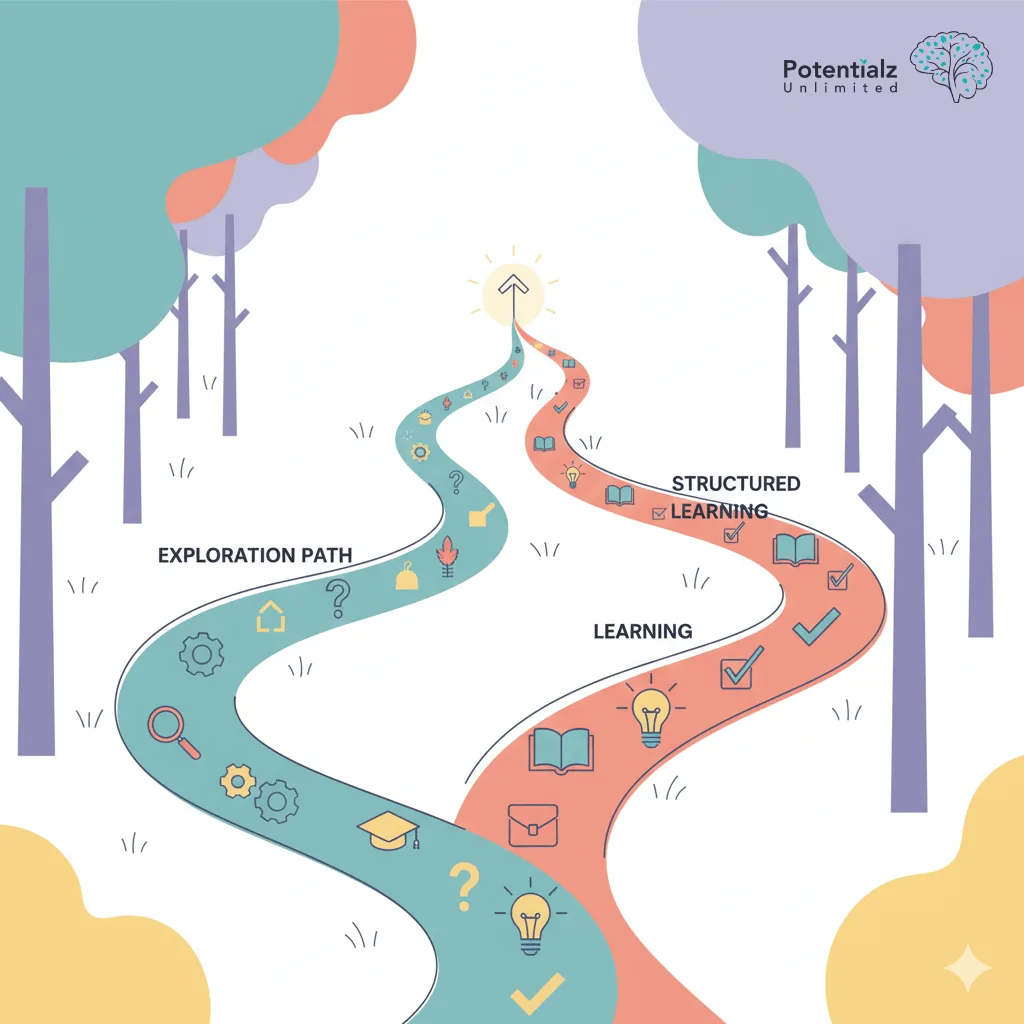 Two pathways through the forest symbolize distinct learning journeys: the exploration path and structured learning, both guiding forward to new horizons.
Cognitive Skills Across the Lifespan: It’s Never Too Late
While we often focus on children’s cognitive development, adults continue using and developing cognitive skills throughout life. Whether you’re a young adult establishing a career, a parent managing family demands, or an older adult maintaining cognitive health, these skills remain central to daily functioning.
Adult Cognitive Challenges
Work-Related Demands: Modern workplaces require significant cognitive resources—managing multiple projects, making complex decisions, adapting to changes, and learning new technologies.
Parenting and Caregiving: Managing children’s schedules, supporting their learning, making countless daily decisions, and regulating your own emotions while helping children regulate theirs all demand considerable cognitive capacity.
Life Transitions: Starting new jobs, moving, relationship changes, or managing health conditions can temporarily overwhelm cognitive resources, making even routine tasks feel harder.
Cognitive Changes: While significant cognitive decline isn’t normal aging, some changes are typical—slightly slower processing speed, occasional memory lapses, needing more time to learn new skills. Understanding normal aging reduces anxiety about these changes.
Supporting Adult Cognitive Health
Continued Learning: Learning new skills—languages, instruments, hobbies, or professional development—builds cognitive reserve and maintains brain plasticity.
Social Engagement: Meaningful relationships and social interaction protect cognitive function. Isolation is a risk factor for cognitive decline.
Physical Health: Exercise, nutrition, sleep, and managing chronic conditions all impact cognitive function. Cardiovascular health directly affects brain health.
Mental Health: Depression, anxiety, and chronic stress significantly impair cognitive function. Treating mental health conditions often restores cognitive abilities.
Purpose and Meaning: Having goals and meaningful activities protects cognitive health and life satisfaction.
For adults experiencing cognitive difficulties, memory concerns, or wanting to optimize cognitive function, our clinical psychologists provide assessment and support tailored to adult needs.
 An older adult fully immersed in learning to paint, exemplifying concentration and the joy of discovering new skills.
Moving Forward: Next Steps for Your Family
Understanding how cognitive skills impact learning and problem-solving empowers you to support yourself and your family more effectively. Whether cognitive development is generally on track or you’re facing specific challenges, there are clear paths forward.
If Things Are Going Well
Continue Supporting Development:
- Maintain routines that support cognitive health (sleep, nutrition, exercise, social connection)
- Provide diverse learning opportunities
- Balance structured activities with unstructured time
- Stay connected and communicate openly
- Celebrate effort and growth, not just achievements
If You Have Concerns
Start with Conversation: Talk with teachers, family, or the person themselves about what you’re noticing. Sometimes different perspectives clarify whether concerns are significant.
Gather Information: Note specific examples of difficulties—when they happen, what seems to trigger them, what helps. Patterns provide valuable information.
Consult Professionals: Don’t wait years hoping challenges will resolve. Early assessment and intervention prevent secondary issues like anxiety, low self-esteem, or behavioral problems that develop from ongoing frustration.
Consider Assessment: Comprehensive cognitive assessment provides:
- Clear understanding of strengths and challenges
- Specific recommendations for home and school
- Baseline for monitoring progress
- Peace of mind from understanding what’s happening
How to Access Support in Bella Vista
Our practice in Bella Vista serves families throughout the Hills District—from Norwest and Castle Hill to Kellyville, Baulkham Hills, and Rouse Hill. We provide:
- Comprehensive cognitive assessments for children, adolescents, and adults
- Educational and workplace recommendations
- Therapy for related concerns including anxiety, ADHD, and learning-related stress
- NDIS psychology services for eligible individuals
- Family support to help everyone navigate cognitive challenges together
Dr. Gurprit Ganda, with over 22 years of clinical experience, leads our team of experienced psychologists who understand the unique needs of families in our multicultural community.
To Get Started:
- Call our practice to discuss your concerns
- Book an initial consultation
- Complete a comprehensive assessment if recommended
- Receive a detailed report with practical strategies
- Access ongoing support as needed
You can contact us or learn more about our team of psychologists who are ready to support your family’s cognitive and emotional wellbeing.
 Bright and inviting reception area featuring cozy seating and lush greenery, creating a warm and professional atmosphere that immediately puts visitors at ease.
Test your Knowledge
Conclusion: Celebrating Every Step Forward
Understanding how cognitive skills impact learning and problem-solving opens doors to better support, reduced frustration, and increased confidence for everyone in your family. Whether you’re helping your child with homework in Castle Hill, managing work demands in Norwest, or supporting a teenager through high school in Kellyville, these insights can make daily life smoother.
Remember these key points:
Cognitive skills are like mental tools—different tasks require different tools, and everyone has unique strengths and challenges.
These skills can be strengthened—through everyday activities, supportive environments, and sometimes professional help.
Struggles aren’t failures—they’re signals that someone needs a different approach, additional support, or understanding of how their brain works best.
Assessment provides clarity—when concerns persist, comprehensive evaluation guides effective support rather than continued guessing.
Support is available—you don’t have to navigate these challenges alone.
For families in Bella Vista and throughout the Hills District, our practice is here to support your cognitive and emotional wellbeing journey. Every person has potential waiting to be understood and nurtured. With the right support, challenges become opportunities for growth.
If you’re ready to take the next step in understanding cognitive strengths and challenges, we invite you to reach out. Sometimes the most important decision is simply deciding to seek understanding rather than continuing to struggle alone.
 A new day dawns with hope and community as the sun rises over a friendly neighborhood, symbolizing connection and positivity.
References
- Bialystok, E. (2009). Bilingualism: The good, the bad, and the indifferent. Bilingualism: Language and Cognition, 12(1), 3-11. https://doi.org/10.1017/S1366728908003477
- Deary, I. J., Strand, S., Smith, P., & Fernandes, C. (2007). Intelligence and educational achievement. Intelligence, 35(1), 13-21. https://doi.org/10.1016/j.intell.2006.02.001
- Diamond, A. (2013). Executive functions. Annual Review of Psychology, 64, 135-168. https://doi.org/10.1146/annurev-psych-113011-143750
- Pontifex, M. B., Saliba, B. J., Raine, L. B., Picchietti, D. L., & Hillman, C. H. (2013). Exercise improves behavioral, neurocognitive, and scholastic performance in children with attention-deficit/hyperactivity disorder. Journal of Pediatrics, 162(3), 543-551. https://doi.org/10.1016/j.jpeds.2012.08.036
- Strauss, E., Sherman, E. M. S., & Spreen, O. (2006). A compendium of neuropsychological tests: Administration, norms, and commentary (3rd ed.). Oxford University Press.
- Tamana, S. K., Ezeugwu, V., Chikuma, J., Lefebvre, D. L., Azad, M. B., Moraes, T. J., … & Mandhane, P. J. (2019). Screen-time is associated with inattention problems in preschoolers: Results from the CHILD birth cohort study. PLOS ONE, 14(4), e0213995. https://doi.org/10.1371/journal.pone.0213995
- Walker, M. P. (2017). Why we sleep: Unlocking the power of sleep and dreams. Scribner.
Need Professional Support?
If you're experiencing mental health concerns, our team is here to help.